
Power to the People
How Labour can restore civic life and counter the "Britain is broken" narrative

We have a guest post today from James Plunkett - who wrote for us back in July on why the government’s attempt to work on five big “missions” was proving so difficult.
James leads Kinship Works, an initiative supporting more human ways of making society better, as alternatives to top down bureaucratic methods. James has worked for nearly 20 years in and around the UK government, from Number 10 and the Cabinet Office to leadership roles at Resolution Foundation, Citizens Advice, and Nesta. Before that, he was a Kennedy Scholar at Harvard.
This post shares insights from research James has been leading on Big Local, a National Lottery-funded programme that started in 2010 to support communities with low social capital, and which ends this year. It’s a companion post to the one I wrote last week on “troubleshooting”. That was about technocratic fixes to the daily frustrations we experience with the state: this is about a more fundamental shift in the relationship between the state and the public.
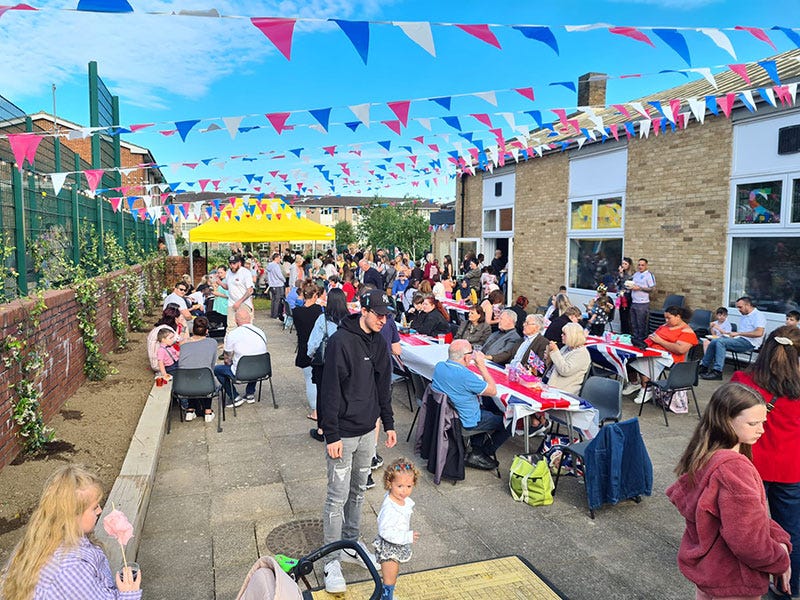
The most interesting changes in politics often happen within parties, not between them. One such shift we’re seeing in Labour at the moment is a revival of the party’s communitarian instincts. Although associated with Blue Labour in the early 2010s, this push is now coming from a wider range of voices, from leading members of the new MP intake to senior political appointees. It advocates a less managerial agenda than New Labour’s, arguing that national renewal - and Labour’s electoral fortunes - rest not just on economic growth and some key deliverables, but on fostering a revival of civic life. This taps into a point Sam has made before; that people are generally more positive about their local area than they are about the country, so centring local communities can help to tackle the “Britain is broken” narrative.
If one policy defines the shift, and highlights the tensions that come with it, it is Pride in Place. This is Labour’s plan to invest £5 billion into left-behind neighbourhoods, extending and adapting the previous government’s “Levelling Up” agenda. Cynics see Pride in Place as electoral politics dressed up as community empowerment, but there’s good reason to think it’s a more genuine effort. The government is targeting areas not only using the traditional Index of Multiple Deprivation, but also with a more novel dataset, the Community Needs Index, which measures the health of the social fabric. In the programme’s latest prospectus, Labour pushed the work in a less top down direction, requiring local areas to pivot to a model of community-led delivery over three years. Pride in Place also draws on an increasingly impressive body of work from the Independent Commission on Neighbourhoods, and the personal expertise of key No 10 figures, like Vidhya Alakeson and now Jessica Studdert. Plus the push for community is being backed by influential philanthropists.
So the communitarian revival is, I think, serious. But a worry remains that, despite good intentions, programmes like Pride in Place will drift back to being technocratic as they are implemented. I think this is a real risk and it is one that Labour should resist. But more interestingly I think it’s a risk Labour can resist thanks to advances in what we could think of as the communitarian statecraft - a way to use the power of the state not just to drive bureaucratic deliverables for people, but to cultivate the capacity of communities to make life better.
In this post I’ll unpack these advances, which are still quite poorly understood. I’ll focus on the evidence from one especially instructive programme, Big Local, a 15 year, £271m experiment in restoring civic capacity, which ends this year. I’ll describe the evidence from Big Local and see what lessons can be applied to Pride in Place. Then I’ll end with a few words on the other critique that is often made of communitarians - that their agenda is bad politics. I think the evidence has tipped in their favour here too, but more on that in a moment.
We know how to do it
The communitarian agenda has wide-ranging implications for government. As set out in a recent report by leading progressive thinkers, it entails a bolder push on devolution; a willingness to stand up to the isolating and alienating effects of unfettered markets; and a more morally confident, emotionally engaging style of leadership. One challenge that runs through this agenda relates to statecraft - if you want to use the state to cultivate community life, how do you go about it?
In the last 15 years, a number of large-scale experiments have helped to answer this question. Often funded by forward-thinking foundations or philanthropists, rather than governments, this work has built an impressive evidence base. In Britain, we have hosted one of the biggest such experiments, Big Local, which produced over 100 research reports and 60 policy reports, from statistical evaluations to in-depth ethnographies. This adds to lessons from similar initiatives around the world, from Communities for Children in Australia, to Purpose Built Communities in America, as well as previous UK programmes like the New Deal for Communities. So let’s look at the evidence on impact before turning to the implications for policy and politics.
The impact of Big Local
Starting in 2010, Big Local used £271m of funding from the National Lottery to support community-led renewal in 150 neighbourhoods over 10-15 years. The programme broke away from a traditional mentality of funding pre-specified deliverables, and instead used the Lottery’s freedom from budget cycles and electoral pressures to give long-term money to communities to do what they felt was needed, without onerous requirements. The money was even distributed via Locally Trusted Organisations that communities themselves nominated.
How did communities spend the money? Studies describe a diverse array of activities - from over-50s lunch clubs and community gardens, to micro-grants and social enterprise incubators, to ‘knit and natter’ circles and skateparks - many of which grew into sustainable local businesses (see case studies here and here). More than two thirds of local areas invested in some form of community space or asset, often reviving a dilapidated building into a community centre (see examples here). Evidence suggests that this local activity then fed into measures of community engagement. People involved in Big Local reported feeling more connected, better able to navigate institutions to get things done, and said they felt a growing sense of confidence and collective efficacy (see here and here).
Evidence suggests Big Local areas put their improved capacities to use. Across the 150 areas, communities drew in additional investment, attracted or built new businesses, secured new transport links, and created new routes into work (see here and here). A multi-year evaluation suggests that these changes fed through into social outcomes (see here). Big Local areas saw small but statistically significant population-level decreases in burglary, and those that spent their money promptly saw improvements to population-level mental health. Big Local areas also bucked trends on health inequality compared to similarly deprived areas; and, during Covid, they proved more resilient. In terms of the money spent and the social value delivered, the programme is estimated to have generated a sizable return.
These findings are more striking when you consider how small Big Local was in the grand scheme of things. Although the programme was ambitious in its philosophy, £1m over 10 years spreads thin. The average Big Local area had a population of 7,900, so the money amounted to roughly £11.30 per person per year. That is around 7% of the planned investment via Pride in Place (although most of the latter is restricted to capital spending). To give a sense of scale, relative to total household income in the average Big Local area, the programme was like adding two teaspoons to an eight litre bucket of water.
Big Local’s impact therefore hints at the potent power of civic capacity, and this mirrors evidence from similar initiatives in other countries. We often lament the downward spirals that can blight communities - a factory closes, people lose hope, and this feeds further decline. But programmes like these suggest that these spirals can also go upward - if confidence is rekindled, this can lead to small wins, which build more confidence. This reflects a special quality of social capital: it is the only form of capital that grows when you spend it, and depletes when you don’t.
How Big Local did it
I think these findings are consequential. They endorse the communitarian idea that there are active paths to social progress that are civic, as opposed to technocratic. But let’s get more specific and look at how these insights could translate into a programme like Pride in Place.
In a recent report from Kinship Works, we suggested that the practice of civic renewal could be likened to rewilding in environmentalism. Rewilding is a respected strategy in conservation, backed by bodies like the IUCN. It uses a suite of methods to tease out and support processes that are organic and locally rooted. In the report, we argued that the work of civic renewal applies a similar quality of touch and attention. It even uses similar methods. Consider how important it is to restore civic habitats like youth clubs, community centres, and libraries - environments in which civic life can thrive.
If we think about the work in this way, what does this mean for the methods we should use? Successful initiatives seem to play out in three phases.
1. Protect local space
In phase one, a programme carves out and protects local space in communities. This is done by distributing long-term funding to communities without strings attached. In Big Local, the institutional setup also helped to guard against the instinct to meddle in how the money was spent - the work was doubly arm’s-length from government, funded by the National Lottery and delivered by Local Trust, an independent body. The programme also let local people decide how to govern the work. This didn’t just allow more space to do the work; it also meant that governance was cultivated as a local capacity, growing like a supporting structure around the work, and enduring beyond it.
2. The community instinct
In phase two, communities step into the space the programme has created, using the money and freedom to do work they care about, in line with their instincts. This is where we see lots of diversity because every place is different. But if we step back, we also see commonalities in the way communities do things. Together, these characterise what I think of as a ‘community instinct’ - one that contrasts starkly with the state’s more bureaucratic instincts; indeed it’s almost the opposite.
One common feature of community-led development is that the work is positive. This differs from traditional policy-making, which has fallen into a fairly miserabilist narrative. In policy we tend to talk in terms of crisis - ‘the care crisis’, ‘the housing crisis’, ‘the mental health epidemic’ - and our methods are almost wholly remedial; we start with a problem and we try to make it less bad. Communities, on the other hand, often start with assets. What is our community good at? What are we proud of? What are our hopes for the future? This has the obvious benefit of being less of a buzzkill. It also opens up the possibility of a more inspiring and imaginative form of politics and political leadership, which is a point I’ll come back to.
Another theme of community-led work is that it is human in its forms and methods. Rather than being organised in silos - an NHS Trust, a Job Centre, an Adult Social Care Department - activities in Big Local were arranged around places, events, or life-stages (a meetup for new parents, a youth club, some money advice over a fry up). This is what the jargon calls ‘holistic’ (it came up as a theme in research here and here). The work was also preventative; in fact I’d say it was preventative by instinct. Rather than treating symptoms, it focused on environments or habitual behaviours, supporting healthy eating or exercise, for example, or improving access to green space (see here and here).
The work was also resourceful, repurposing spaces, or linking people into existing services, before designing new ones, and investing in local capacity (see here). But perhaps most of all, the work centred relationships (see here and here). Big Local projects took time to listen to people, often leaving them surprised by the dignity with which they were treated. This made the work even more cost-effective. It wasn’t uncommon for people to say that contact with a Big Local project changed their lives, and, for people facing multiple complex disadvantages, this alone can reduce pressure on public services to the tune of tens of thousands of pounds.
3. Deepening and spreading
Although phase two is where most of the work takes place, phase three is arguably more consequential. It addresses a long-running weakness in communitarian methods - one that is summed up in the question people always ask when they hear about an impressive community project: ‘that sounds good, but does it scale?’
A few years ago, I often found myself bluffing an answer to this question, saying something about the importance of local context. Now, things have progressed enough to give a proper answer. The short version is: ‘yes, the work scales’. But the better version is: ‘the work doesn’t so much scale as spread.’
During the later years of Big Local, the work came together with similar programmes (Power to Change, for example) and with an upswell of local initiatives, in places from Plymouth to Hastings, and with campaigns like We’re Right Here. This has all begun to cohere into more than simply a list of local projects. I think it’s now fair to call it a movement, or - maybe better - a field of civic renewal.
I don’t have space to do justice to the depth and breadth of this new field, but here are some examples to give a flavour of it.
There are now reliable ways to bring communities together to foster a sense of agency and imagination, e.g. Citizen First, or design processes like the 100 Day Challenge. There are disciplines like community stewardship, and networks of people practicing community-led development and sharing lessons, e.g. the work of Stir to Action, or the Mycelial Network. There is work to bring buildings into community ownership, e.g. Platform Places, or the revived Campaign Against Delinquent Ownership, first launched a decade ago by Jericho Road Solutions, supported by Locality. There is a growing advisory market, helping people to use community rights and tools like community share issues. There are civic technologies, e.g. deliberative platforms like Polis that communities can use to find common ground, as well as platforms for running sharing schemes or care networks. There are learning and evaluation methods that suit work that is local and complex, and ways to use data to empower people rather than to just report upwards, e.g. Cornerstone Indicators, or techniques like Theory-Based Evaluation. And there are new institutions - land exchanges, community land trusts, and many others - to serve functions like holding risk, or financing asset transfers.
I think of the field that has been emerging from all of this work as building an equal and opposite to the technocratic method that has long dominated progressive politics. The goal, however, is not to replace technocratic methods entirely, but rather to broaden beyond them, most importantly in the complex domains where technocracy struggles.
But is it good politics?
What this all tells us is that Labour doesn’t need to slide back to its technocratic comfort zone. But there is one reason why they still might, which has less to do with policy and more to do with politics.
These days people often endorse community-led methods but then say these approaches are too slow, or too soft, for the political moment we’re in. They argue that Labour won’t beat Reform with a few knitting circles and lunch clubs. Fighting off rightwing populism will need more muscular political leadership - a way to show that a progressive state can deliver.
I wouldn’t reject this argument entirely. After years of unstable and often unserious government, there is value in administrative competence - just getting a grip on a few key deliverables. And for all of the legitimate communitarian critiques of New Labour, there are lots of examples from 1997-2010 of deliverology making a difference. So in some areas - NHS waiting lists for standardised procedures, or a legislative agenda like planning reform - there is value in political leaders who know how to get a technocratic system to deliver.
Overall, however, I am with those who say the idea of government as lever-pulling is dangerously limited and far too dominant. So to get clearer on the limits of technocracy, let’s end by circling back to Pride in Place’s predecessor, the New Deal for Communities.
From 1998 to 2011, NDC invested nearly £2bn into 39 neighbourhoods. It talked a good talk on community, but really it was top down regeneration led by public institutions. In the words of one of the programme’s main evaluators, Professor Stephen Lawless, NDC was “locality managerialism”. So if we want to know what technocracy is and isn’t good for, NDC’s results are illuminating.
On the one hand, NDC delivered. Thousands of homes were refurbished, high streets were upgraded, and people noticed. Fear of crime fell faster in NDC areas and more people said their area was getting better. But what about community life? Of eleven measures of social capital, only one rose significantly thanks to NDC, while the share of people who said they ‘felt part of the community’ actually rose less in NDC areas than in comparable places (see here and here). Visit old NDC neighbourhoods today and you might see a few faded plaques on buildings that were renovated, but you’d be hard pressed to feel an enduring sentiment. And you’d also have struggled to see NDC’s impact in the Brexit vote, which followed just five years later.
If the last decade, from Brexit to Biden, saw the very public failure of a technocratic Left politics, then the evidence from initiatives like NDC helps to explain why. And it also shows the likely outcome of a scenario in which Pride in Place drifts back to these methods. It reminds us that technocratic methods have a power to them, but it is a blunt power - good for things like capital projects, but exceptionally bad for making human beings feel they’ve been heard and listened to. This is partly because technocracy can’t hear in enough fidelity, or act with enough dexterity, to move quickly on the small things that define how life feels (notice how technocratic programmes are prone to making white elephants, spending millions on buildings no-one cares about, while missing the litter-strewn alley that has become symbolic of local decline). But more profoundly, it’s because technocracy lacks an emotional register. It can’t speak in sentiments like pride, agency, and a felt sense of momentum - precisely the sentiments that are abundant in community-led development.
Can a genuinely communitarian version of Pride in Place save Britain, and Labour? It would be going too far to say yes. Our loss of faith in public life is so multifaceted that there can’t just be one simple answer. But what is clear is that some modes and styles of government are better suited to the moment than others. And on this, I think the evidence has now tipped firmly in the communitarians’ favour. The less managerial approaches they advocate aren’t just good policy, they’re good politics too. And, thanks to a burgeoning field, they are also more practicable than ever.
 | A guest post by
|
Many thanks, James, but I'm not sure that the people to whom such programmes and progressive verbal niceties are addressed would understand a word you are saying; it all sounds still like a sociologist's velvet glove on a steel technocratic hand, disguised top-down stuff. Once one has lost the confidence of the people and have demonstrably preached to them about one's virtues, qualities and purpose for past decades and the relevance of one's past and current ideas with such apaulling results for the people and local communities themselves, it can only be earned back if, firstly, one admits one was wrong. Only then can one fundamentally rebuild oneself around a more humble, attentive, listening, political persona. It takes a generation or more to achieve. Labour's and the Tories' past sins need to be atoned, no pardon in view I'm afraid.
This is fantastic to see and I really hope it is a sustainable direction of travel. Over the last few years I’ve seen a big shift in funding, unfortunately, moving in a direction counter to this. A desire to only fund sure things and to move away from relatively small funding to only working at a system level where control sits with the traditional actors.
The level of risk aversion seems to have increased dramatically and I think has been a response to the “we need impact now” call to action. It is short sighted and it will take a state with at least a little confidence to lead in using funding as you’ve described