
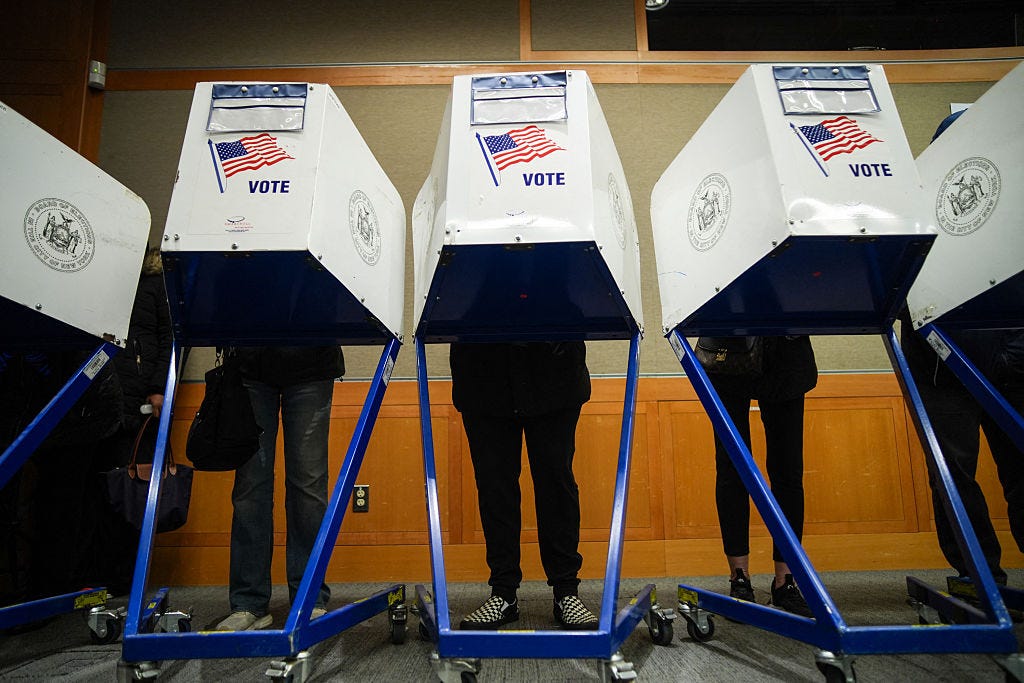
There have been a lot of important elections over the past few weeks, but none more significant for the world than the US midterms on Tuesday. A strongly Democratic Congress won’t stop Trump from doing damage, but it will make his life a lot harder, tying up the administration in investigations and impeachment hearings for the next two years. It would also give the Democrats a good shot at a legislative/executive trifecta in 2028.
A year ago, the received wisdom was that the Democrats would probably win the House but the Senate would be a stretch. But things have got progressively better for them, especially after Trump launched his ill-fated war on Iran. Now the House looks almost certain to fall, and the Senate is odds-on. The latter is still hard to call, though, because swings towards the Democrats have been larger in red states, meaning there are an unusually large number of seats where polling is within the margin of error. It is plausible the Republicans could hold on to their current majority (53-47), or that the Democrats could win 54-46. Or perhaps by even more, given the Republicans seem to be panicking about states that forecasters have assumed were safe for them, like Louisiana and Mississippi.
Well over a third of the likely electorate has already voted. It is notoriously difficult to read much into the limited information we get in different states about the demographics and affiliations of early voters. But we can at least say there is nothing obvious in the data that suggests polls are badly wrong. It looks like the Democrats are doing a good job of turning out their key demographics, particularly younger Hispanic and Black voters in the South.
Meanwhile, the most recent polls, as undecided voters make up their minds, still seem to be edging towards the Democrats. They could definitely still lose the Senate, but I would much rather be in their position now than their opponents.
In the rest of the post, I’m going to give an hour-by-hour breakdown of when votes from each state will come in, which races to focus on and what, if anything, we know from early voting. This should ensure you are fully prepared if you’re watching live, or are in a position to interpret the results when you wake up on Wednesday morning. Remember, US elections don’t have voting-intention exit polls, so the only way to understand what’s going on is to know how to interpret votes as they come in. At the end I make some predictions.
You can also read my posts on why I don’t think Trump can steal or rig these elections from earlier in the year (an assessment that has so far been correct), and my more recent one on what the Democrats could do with Congressional power if they do win.