
When I joined the Department for Education as an adviser in 2010, all anyone wanted to talk about was Finland. In the first few rounds of the OECD’s PISA survey – which gives 15-year-olds around the world a comparable test – the Finns had outperformed everyone bar a handful of Far Eastern nations. A whole industry built up around it; delegations of policymakers and headteachers made up a substantial proportion of Helsinki’s tourism profits. There were books and TED talks.
A few of us tried to point out that Finland’s success was probably due to policy made in the 1980s and 1990s, not the new and more progressive ideas they were now experimenting with. Regardless, numerous countries decided to adopt a similar shift towards “competency-based” curricula – which are more focused on what young people should be able to do than the material they should learn. Scotland and Wales both went down this route.
England took a different path, retaining a curriculum that set out the core knowledge all children should know. There was also more focus on behaviour, high-stakes assessment, and synthetic phonics for younger children learning to read. All of this was considered by many to be backwards-looking, Gradgrindian, and likely to disengage students.
In the 2025 version of PISA, released earlier in the month, England was the second-highest-performing country in the world outside the Far East.1 Only Estonia did better. England has pulled further ahead of the other UK nations. (As a rough guide, a 20-point difference in scores is equivalent to a year of learning).
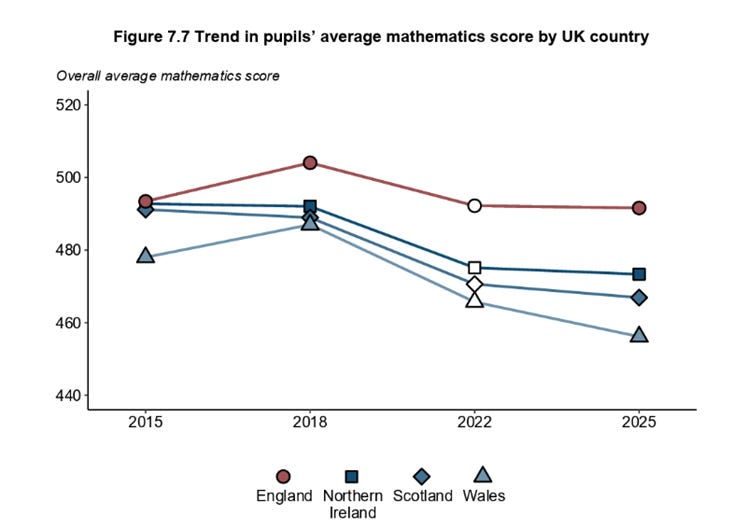
It is also doing much better than other Western European countries. This has been reported widely, but the extent of the gap has been underplayed. For example, in reading, the 25% most disadvantaged young people in England outperformed the average for all students in Germany, France, the Netherlands, Norway and many other countries. The overall gap has gone from nothing to significant in a decade.
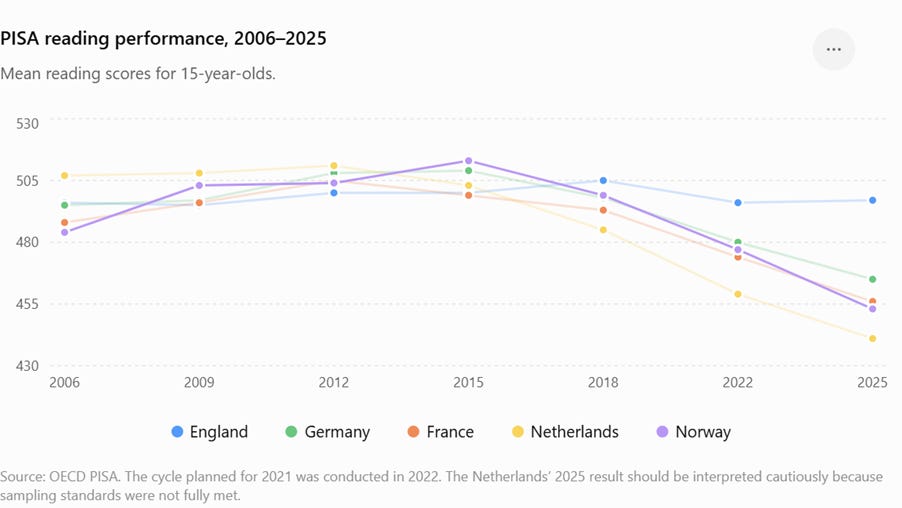
This is extraordinary, and inconvenient for a lot of people here who campaigned against the English reforms. We have seen a barrage of attempts to explain away our success. One popular argument is that we have not improved, it is just that other countries have got worse. This is true, except in science where England’s results did go up. But staying still, in the face of headwinds, while nearly everyone else drops back precipitously is still an achievement. Another is to nitpick the methodology and sampling. Check the footnote if you want the details, but these are minor issues and will have made little difference to England’s scores or the overall picture.2
Back in 2010, I hoped that one day delegations would be coming here instead. That might be starting to happen. In the past few weeks I have had calls from journalists in France, Germany, the Netherlands, and even Japan, asking how England has avoided the falls seen elsewhere. So I’ve dug into the reams of data that PISA provides, to see what we can learn. How much is about policy versus other cultural factors, and particularly migration, given England’s immigrants do very well? How important is our cautious approach to technology in the classroom? Why have other countries seen such a drop-off, and are we just delaying the inevitable? And what are our areas for improvement?