


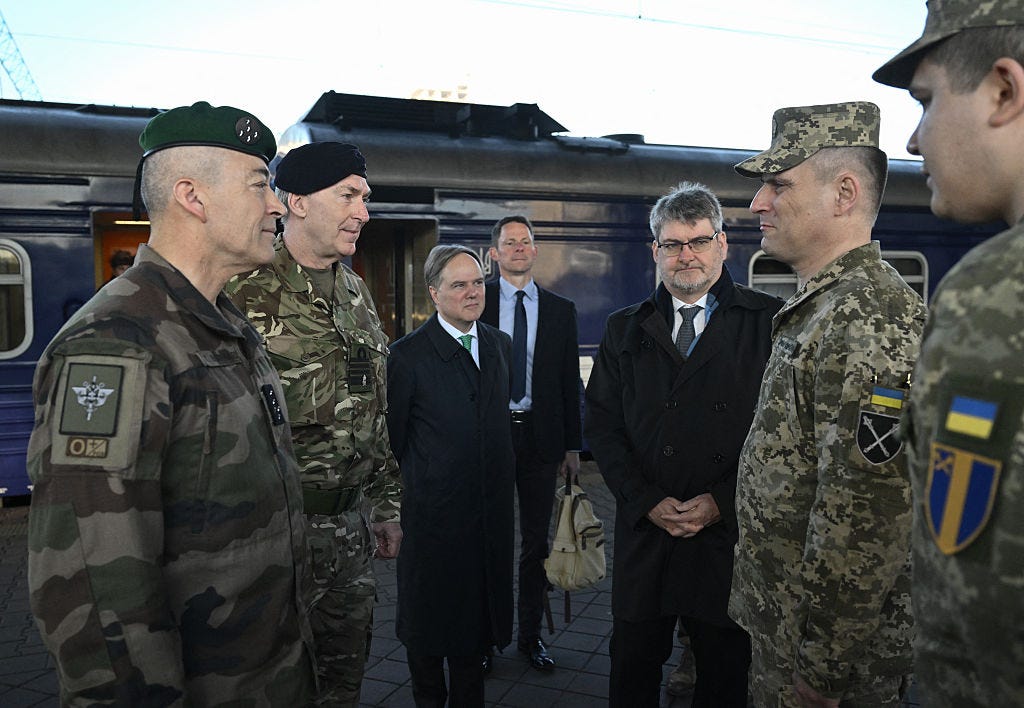
Admiral SirTony Radakin retired as Chief of the Defence Staff, the head of the UK armed forces, a year ago. His tenure as CDS, from 2021-25, spanned four Prime Ministers, Russia’s full illegal invasion of Ukraine and the events in the Middle East following 7 Oct 2023. (He is pictured above, 2nd left, on a visit to Kyiv).
In this extensive interview we covered a lot of ground, providing many insights into recent policy-making and current security challenges. It was so interesting that we have decided to publish in two parts. Tomorrow we will cover the problems facing the defence budget and the way we procure new weapons. But first, today, in part one, we cover Ukraine, what it has taught us about the needs of the British military, and the wider Russian threat.
Admiral Radakin was commissioned in 1990. He has held multiple joint and international command and operational roles worldwide, including tours in the Gulf, Falklands, Adriatic, Hong Kong, the Caribbean and three commands in Iraq. Prior to becoming CDS, he was First Sea Lord. He is a qualified barrister with an MA in International Relations and Defence Studies, a Distinguished Fellow of the Atlantic Council, a board member of the Kyiv Security Forum, a Patron of the SBS Association and Colonel Commandant of the SBS.
Lawrence: We made an early commitment to Ukraine, and subsequently, we took some quite forward positions on how prominently we could support Ukraine. How was that decision made?
Tony: We were helped by extraordinary intelligence that meant we were very confident Russia was going to invade. I came in as CDS in early November 2021, and I was being told even before then that I needed to brush up on Russia. Then you accelerate into early 2022, and the intelligence was used to try to stave off war. Liz Truss [as foreign secretary] went to Moscow. I went with Ben Wallace and had meetings with [Defence Minister] Shoigu and [Commander-in-Chief] Gerasimov, and very frank conversations. We said, “You’ve got 140,000 troops on the border. We think you’re going to invade.” And we got back, “We have no intentions to invade.”
We were already close to Ukraine, particularly through the navy and our land forces. We were really anxious. Did Ukraine have proper plans to defend itself? Ben Wallace at one point ordered [Minister of State] James Heappey to Kyiv and he was not allowed to come back until he had the plans. What he came back with was, frankly, more a set of crayon drawings than plans. And we all thought, oh shit. We learned subsequently that it was part of Kyiv’s op-sec [operational security] even with us.
We had conversations going on about NLAWs [Next-generation Light Anti-tank Weapons]. Prime Minister Johnson, maybe five days before the actual invasion, had a ministerial small group where he debated what we were going to do when Russia invaded. That was balanced and wasn’t decisive. In a very Johnsonian way, he wanted a paper on either supporting Ukraine or looking the other way. And the argument pushed about not supporting was that Ukraine would always be more important for Russia than it would be for the UK, and there would be consequences for us, predominantly economically.
When Russia finally attacked, it felt to me like a political tsunami. We went across to the 7 o’clock in the morning Cobra. By the time that Boris Johnson had got to his seat at the table, he had already said that we are all in in support of Ukraine. The conversation was about the sanctions packages that had been prepared, which were much stronger, I think, than Russia anticipated. What is required to make this effective? You need international alignment. That went on that morning.