
Whatever Happened to Arms Control?

‘Bertie sustained simultaneously a pair of opinions ludicrously incompatible. He held that in fact human affairs were carried on after a most irrational fashion, but that the remedy was quite simply and easy since all we had to do was carry them on rationally. A discussion of practical affairs on these lines was really very boring.’
John Maynard Keynes on Bertrand Russell
To Bertrand Russell, already a pacifist and later a leading light in the campaign for nuclear disarmament, war was the ultimate irrationality. Once nuclear weapons entered the picture it was the ultimate insanity. Seventy years ago, in July 1955, he issued a manifesto jointly with Albert Einstein for discussion at a scientific Congress:
‘In view of the fact that in any future world war nuclear weapons will certainly be employed, and that such weapons threaten the continued existence of mankind, we urge the governments of the world to realize, and to acknowledge publicly, that their purpose cannot be furthered by a world war, and we urge them, consequently, to find peaceful means for the settlement of all matters of dispute between them.’
The arrival of thermonuclear weapons had added urgency to demands for the abolition of war. The manifesto warned that however important renunciation of such weapons might be as a ‘first step,’ showing political goodwill, it would not be enough. As soon as a war broke out they could return.
‘Here, then, is the problem which we present to you, stark and dreadful, and inescapable: Shall we put an end to the human race: or shall mankind renounce war?’
The renunciation war was not a new idea. Indeed it had already been proclaimed by the major powers. In Paris in 1928, a ‘General Treaty for Renunciation of War as an Instrument of National Policy’, put together by the US Secretary of State Frank Kellogg and the French Foreign Minister Aristide Briand, was signed by most of the major powers of the time. It was short and sweet:
Article I
The High Contracting Parties solemnly declare in the names of their respective peoples that they condemn recourse to war for the solution of international controversies and renounce it as an instrument of national policy in their relations with one another.
Article II
The High Contracting Parties agree that the settlement or solution of all disputes or conflicts of whatever nature or of whatever origin they may be, which may arise among them, shall never be sought except by pacific means.
The Treaty remains in place. Despite the fact that the Second World War came not long after, the underlying sentiment made its way into the 1945 Charter of the United Nations, and it provided the justification for putting leading Nazis on trial for crimes against peace at Nuremberg. What it did not do was stop wars.
In one respect the Russell-Einstein manifesto succeeded. Political leaders regularly support the underlying sentiment, especially when it comes to nuclear war. At a summit in 1988 Presidents Reagan and Gorbachev made the following statement.
They reaffirmed their solemn conviction that a nuclear war cannot be won and must never be fought, their determination to prevent any war between the United States and Soviet Union, whether nuclear or conventional, and their disavowal of any intention to achieve military superiority.
This has been repeated by the leaders of nuclear-armed countries on a regular basis, including Vladimir Putin. And thankfully there has yet to be a nuclear war or indeed any war directly between the major powers. But sometimes, including now, matters can seem perilously close to major war, and there is little confidence that any war between the major powers once begun will not go nuclear. Can we be confident that political leaders will continue to show self-restraint under all circumstances, just because they too are scared of nuclear conflict?
If we are not confident then, as Russell insisted in his later years, shouldn’t we make it impossible to wage such catastrophic wars by removing the means to do so? This reflected the spirit that animated numerous international disarmament conferences, starting with those that took place in the Hague in 1899 and 1907. If war could not be legislated out of existence then perhaps the most dangerous and obnoxious weapons might be. With fewer weapons, or better still none at all, then there should be more peace. This required persuading the very political leaders who could not be trusted to keep the peace to agree together to abandon the instruments of war.
The limited results from years of disarmament conferences and initiatives, eventually led to a third view, which seemed to the disarmers quite perverse. This was prompted by the caution that had been introduced into international affairs by the arrival of nuclear weapons. The inescapable possibility of a catastrophic war was a powerful argument for peace. On this basis ‘arms control’ was posed as an alternative to disarmament. If it was going to prove to hard to eliminate nuclear weapons then the role of international agreements was to help us live with them.
At the moment many wars are still being fought at high levels of violence and attempts to regulate the acquisition and use of armaments through international negotiations have turned out to be inadequate and are now barely being attempted. Despite past hopes that progressive disarmament would lead nations to sort out their differences through non-violent means, as levels of tension rise and of trust go down, agreements become even harder to negotiate and existing ones are abandoned or just ignored. Unlike the days when a few great powers could gather and decide on the future of the world, there are numerous states of all shapes and sizes, with a variety of grievances and ambitions. Many of the new technologies that cause concern are not amenable to traditional forms of control. Does this mean that this whole enterprise is bound to fail?
To answer the question, as always the best place to start is with a brief historical survey. This will show that the practice of both arms control and disarmament has never quite lived up to the hopes of their proponents.
Before The First World War
The story begins in the late 19th Century with concerns about new destructive weapons leading to greater suffering on the battlefield, a greater exposure of commerce and civilian life to military attack, and a greater strain on national resources.
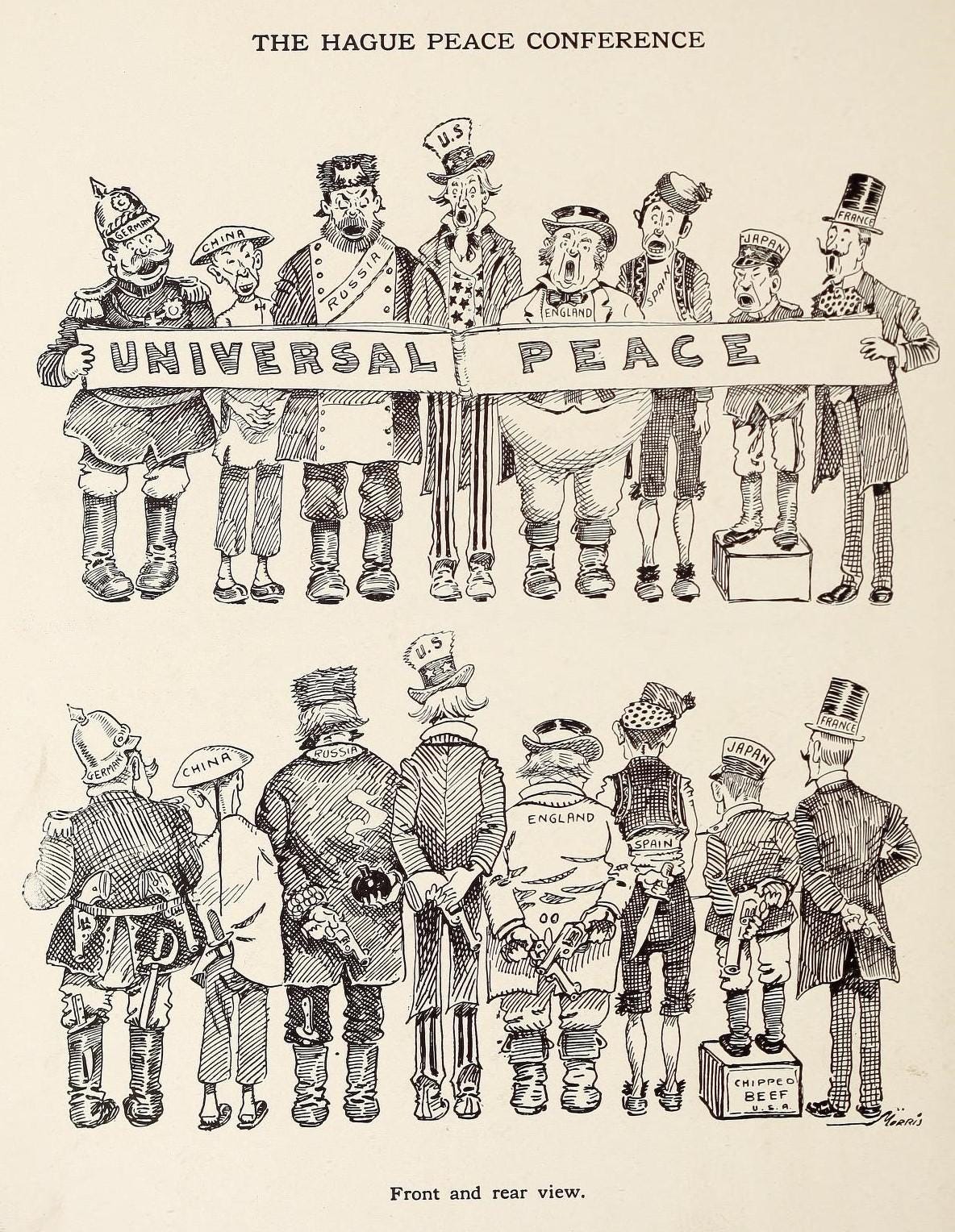
These concerns shaped the Hague Conferences. Conventions were drawn up to ban the destructive novelties of high explosives, asphyxiating gases, submarines and 'diving torpedo boats', and the discharge of 'any kind of projectiles or explosives from balloons or by similar means'. The 'military' was to be strictly separated from the 'civilian' with attacks on undefended 'towns, villages, dwellings or buildings' prohibited.
One of my favourite critiques of these negotiations comes from the saloon-bar philosopher Martin Dooley, the creation of the American humourist Finley Peter Dunne. In a commentary on the Hague Peace conference of 1907, Dooley explained how the Tsar had called a meeting of ‘the Powers’ in Holland to devote their time ‘to making war impossible in the future.’ When there was an early call, however, for ‘the Powers’ to agree to immediate disarmament they all opposed it. The motion was only supported by ‘the Weaknesses’.
To demonstrate the self-serving nature of the negotiations, Dooley described the ‘excitement’ created by the ‘delegate from the cannibal islands who proposed that prisoners-of-war be eaten’.
‘The German delegate thought that this was carrying a special gift of one power too far. It would give the cannibal islands a distinct advantage in case of war, as European soldiers were accustomed to horses. The English delegate said that while much could be said against a practice which personally seemed to him rather unsportsmanlike, still he felt he must reserve the right of any cannibal allies of Britannia to go as far as they liked.’
(This has been translated from the original, in which Dooley speaks with a thick Irish brogue, so that delegate = dillygate)
The Hague Conferences threw into relief the problems pacifists faced when assessing international agreements. If all weapons were bad how could one set be singled out for special treatment while others were left untouched? And if there were advantages to be gained by cheating how was compliance to be enforced? Enforcement would require putting together a war-making capability to get the transgressor into line.
The Hague Conferences illustrated the tension between regulating weapons and eliminating war. They were about containing war’s inherent violence so that it could be sustained as a political institution. As Mr Dooley observed, the ‘larger question’ that concerned the Hague conference was ‘how future wars should be conducted in the best interests of peace’.
The Inter-War Years
The post-1918 disarmament agenda was full. It began with the Treaty of Versailles and the disarmament of Germany, intended to prevent its future return as a military power. No tanks, poison gas, military aircraft or submarines would be produced. All this led to deep resentments in Germany. In the 1930s German cheating became blatant but there was no political will in Britain or France to do anything about it.
The League of Nations Covenant required disarmament ‘to the lowest point consistent with national safety and the enforcement by common action of international obligations,’ as if force levels simply reflected calculations of external danger. The idea was that by reducing their armaments together and proportionately, states would suffer no reduction in their respective levels of security (similar ideas still inform proposals for synchronized nuclear disarmament).
The best example of this was the Washington Naval Conference of 1922. This led to an agreement on capital ships between the United States, British Empire, Japan, France, and Italy which set ratios of 5:5:3:1.7:1.7 respectively. The UK and US were allowed more because they had to keep navies in both the Atlantic and Pacific oceans. The treaty was a political statement which soon made little military sense. The focus was on prestige capital ships. These declined in importance as cruisers, carriers, destroyers and submarines became more important. The naval parity between the British and Americans soon became irrelevant. Japan, placed forever behind them, took this as a slight, contributing to the souring of relations that eventually led to the Pacific war.
Something similar was to be attempted at the Geneva Disarmament Conference which opened in 1932. This failed to produce a comprehensive treaty because of the deteriorating political situation (Hitler came to power while it was underway) and the inherent complexity of the exercise. The greater the number of elements and aspects of military strength covered by negotiators the less chance of reaching an agreement.
There was success with the 1925 Geneva protocol prohibiting the use of 'asphyxiating, poisonous or other gases, and bacteriological methods of warfare.' This did not prevent stockpiling of chemical weapons, so the enforcement mechanism was largely fear of retaliation. As this was a very real fear the Protocol survived the Second World War (although it has been violated many times since). Less successful was the London Protocol of 1936, in which 30 nations agreed to grant the passengers and crew of merchant vessels some protection against submarines. The protocol was too vague in defining when attack became legitimate and failed to acknowledge the structural weaknesses of submarines: they were too small to rescue passengers and crews and too vulnerable to come to the surface to make a visible challenge. It did not last the first month of the war. This illustrated another problem of controlling these systems. Unless the controls match military realities they can soon be pushed aside by the logic of war.
Post-1945
The surge of activity after 1918 was geared to finding ways to preventing future arms races, of the sort that was (erroneously) believed to have caused the First World War. As this effort was followed by the Second World War it came to be cited, especially by those of the ‘realist’ school, as an example of the appeasing mentality which had emboldened the Axis powers . A naïve confidence in peace negotiations was blamed for the Western democracies lowering their guard. To realists strong armed forces seemed a more reliable source of security.
The arrival of nuclear weapons rekindled interest in disarmament but an early attempt to ban them failed as the Cold War, and all the associated suspicions, took hold. By the mid-1950s the opportunity appeared to have passed, with the superpowers now building up their arsenals, although every new reminder of the horrors of nuclear war encouraged a substantial international movement (with Russell to the fore) to demand the abolition of the weapons.
When negotiations did take place they came under the heading of ‘arms control’ – so described to distinguish it from the unrealistic and idealistic ‘disarmament’. The prospectus for arms control was that it was based less on an emotional response to the horror of it all and more on sound strategic theory. It emerged out of an extraordinary fertile period of strategic thinking starting in 1954 and lasting to 1963 as civilian analysts sought ways to make sense of the dilemmas of the nuclear age. The disarmers demanded a world without nuclear weapons, though under prevailing political conditions that was never going to happen. Now that there were two antagonistic powers, each with their own nuclear arsenals, major disarmament would require unlikely levels of trust and cooperation.
The arms controllers argued that what mattered was not the quantity of weapons but the relationship between the two sets of forces. And during the 1950s the thought took hold that perhaps the new relationship was surprisingly stable – war, at least between the two blocs led by the US and the USSR, had become so self-evidently foolish as to be unlikely. An intellectual and policy effort was put into working out how to keep it that way. Don’t worry about cutting numbers for the sake of it: concentrate more on making sure that no side was ever panicked into striking first.
The disarmers, such as Russell, considered mutual deterrence to be dangerous and inherently unstable, and so far less safe than abolishing the weapons. By contrast the arms controllers considered deterrence to be not only inherently stable, and with the right measures could be rendered even more so.
In a recent post I observed that:
Deterrence is a ‘goldilocks’ concept, not too hot and not too cold. It implies a defensive intent without weakness, a determination to prevent aggression without being reckless. To adopt a deterrence strategy is to signal that there is no urge to fight but that there are interests sufficiently vital that they would be fought for. It sustains rather than disrupts the status quo.
‘Arms control’ was its close cousin. Not only was one supposed to reinforce the other, but there was the same attempt to find a middle path between necessary toughness and irresponsible recklessness. To be an arms controller meant that one could claim to trying to make the world a safer place while the avoiding the naïveté of the disarmer. It was also about sustaining the status quo rather than radical transformation. During the first decade of my career, from the mid-1970s to the mid-1980s I described myself as an arms controller. It sounded more virtuous than a deterrer.
Even at large numbers, the situation could be stable so long as the military balance did not create an incentive for either side to initiate hostilities. This essentially meant in the nuclear age, secure second-strike capabilities – the ability to absorb an enemy first strike and still launch a devastating retaliation in response. The inability to prevent retaliation should encourage a potential aggressor to hesitate before doing anything rash and look for alternative means to resolve whatever was in dispute. This state of affairs, under the condition eventually described as Mutual Assured Destruction, was already largely in place and was confirmed by the mid-1960s. It influenced leaders in both Washington and Moscow accordingly.
If that was the situation, what exactly was to be done with arms control that was not happening naturally? The answer in the 1960s was to discourage the deployment of ABMs. This was the subject of the 1972 Treaty, but that happened not as an act of mutual self-restraint but because the two sides recognised how easy it was becoming to overwhelm any missile defences by using decoys and multiple warheads. Signing away the right to deploy expensive and useless systems did not seem such a big deal. It was an easy win.
But it was also counter-intuitive. It might mean giving up on a pointless project but it also meant abandoning a dream. That dream – of being able to protect the homeland against an incoming missile attack - never went away and kept on coming back (most recently with Donald Trump’s ‘golden dome’).
Meanwhile on the other side of the ledger it only seemed logical to limit the numbers of offensive systems now that there would be no need to get through defences to reach their targets. Unfortunately, there was no theory to guide negotiators as to how much was enough. The disarmers might say as few as possible, but politically the main problem was to avoid any impression of disadvantage. The guiding principle was 'parity' - a rough equivalence in military strength between two nations that allowed both to claim they were 'second to none'.
In practice arms control turned into a grand accounting exercise, requiring negotiators to find ways to describe the respective arsenals in such a way that they appeared to be largely equal. This had the unfortunate effect of turning conspicuous but largely irrelevant asymmetries into big issues which threatened to derail the negotiations. The new strategic theory argued that asymmetries, even when they were of no military relevance, might nonetheless acquire political importance because of how they were perceived.
After the end of the Cold War this sort of reasoning was not taken quite so seriously as before, which took the urgency out of the negotiations, although they did continue. There were still rationales – the conversations between US and Russian teams could be revealing and illuminating; the very fact of reaching an agreement could send a helpful political signal; the verification arrangements, which were quite intrusive, provided extra intelligence on what the other side was up to.
The Future
The last big arms control agreement – known as New START (for Strategic Arms Reduction Treaty) was signed in 2010 and entered into force in 2011. It was extended in 2021 for another five years, and therefore has one year left. It set limits far lower than those of the original interim agreement of 1972 and covered warheads. The limits are 700 for deployed missiles and bombers and 1,550 for deployed warheads, and a separate limit of 800 for deployed and non-deployed launchers (missile tubes and bombers). It demonstrated that it was possible to maintain strategic deterrence at lower numbers than before, although after the full-scale invasion of Ukraine and the regular references to the dangers of escalation, few looked to the numbers when wondering how much they should be worried.
If New START lapses then the whole arms control regime established during the Cold War will be no more. The most important treaties – on Anti-Ballistic Missiles (ABMs), Intermediate Nuclear forces (INF), and Conventional Forces in Europe (CFE) have long been abandoned.
There is a Treaty on the Prohibition of Nuclear Weapons in place which bans the development, testing, production, stockpiling, stationing, transfer, use and threat of use of nuclear weapons, as well as assistance and encouragement to the prohibited activities. It came into force in 2021. Lots of countries have signed up. None of them, however, are nuclear weapons states, or members of NATO.
The deterioration of relations with the Russian Federation has demonstrated how little resilience agreements can have and how few obstacles they pose to war-making. Russia is sticking to the overall force limits set by New START but it has suspended the notification and inspections required by the Treaty. Despite the much-celebrated Convention on the Prohibition of the Use, Stockpiling, Production and Transfer of Anti-Personnel Mines and on their Destruction of 1997 (the Ottawa Convention), mines have been used extensively by both sides during the Russo-Ukrainian Wear, to the point that a number of NATO countries bordering Russia have now withdrawn from the convention because they do not want to deny themselves an essential form of defence.
Even if some way was found to end the Russo-Ukraine War it will take time to create the conditions for a return to any sort of arms negotiations. In addition to the obvious problems arising out of Russia’s belligerence there are other reasons why we are unlikely to see a return to the sort of negotiations of the past.
First, while it would be wrong to say that there have been no lasting benefits and achievements, the difficulties with trying to gain agreement on force levels and types of weapons is now painfully evident. Starting afresh would be a triumph of hope over experience.
Second, the world has become much more complicated. In past strategic arms talks were handled bilaterally between Washington and Moscow. Now at the very least they would need to include Beijing, and potentially London and Paris. China has shown no great inclination to discuss limits on its arsenal, while it is still catching up with Russia and the US. Anything of universal application has to take account of up to 200 states.
Third, weapons are becoming harder to count, for example drones. Many new capabilities which countries might like to control – for example cyberattacks and artificial intelligence – are as civilian as they are military, and not under state control. Cyberattacks are often mounted by criminal organisations. There can be international cooperation to limit the malign effects of these sorts of technologies, sharing information and cooperating on detection and damage limitation, but these are not the same as past measures which were specifically designed to manage relations between countries that were antagonistic. Some of them are capabilities that are more relevant at times of an uncertain peace than war.
That does not mean that nothing useful can be done to reduce the risks of war and escalation. Part of the value of past arms control lay in the dialogue. It was helpful that senior officers and officials got to know each other and understand each other’s concerns. At times of crisis a means of easy, rapid, and reliable communication might be important to avoid tragic misapprehensions about what the adversary might be up to. ‘Hot-lines’ are perhaps needed even more than before.
Agreements on specific restrictions and verification mechanisms can play a role in peace settlements though these are more likely to be at a micro than macro level. If, for example, a Russo-Ukrainian ceasefire was agreed this could include provisions for the disposition of forces, and what can be allowed close to the line of contact, and methods of verification (possibly involving third parties).
The basic insight behind arms control was that even bitter antagonists could have shared interests, notably but not solely in avoiding nuclear exchanges. This will remain the case, even during a war. The problem is that once an attempt is made to turn these shared interests into treaty language, they trigger internal debates about the risks involved. Unlikely scenarios will be highlighted to explain why particular provisions must be rejected. There will be issues of interpretation, which will be aggravated because of a lack of trust, so that measures that one side considers innocent can be presented by an adversary as non-compliance. When two sides habitually see the worst in each other, it is never going to be easy to get them to agree to provisions which require assuming the best. If trust is needed then that requires resolving political differences and working on improving relations, and sometimes the conflicts run too deep for that to be possible. That is where we are now. Peace does not come through arms control: arms control comes through peace.
The Geneva Protocol of 1925 banned the use of chemical weapons. Apparently no one complied with it.
In 1943, the Allies unloaded a large stock of mustard gas from the U.S. Liberty ship John Harvey in the port of Bari, Italy. The German Luftwaffe attacked the port on 2 December 1943. Several hundred people were exposed to the gas.
The survivors later turned out to have very low white blood cell counts. That knowledge was a reason for treatment of cancer with chemotherapy, as it led researchers to look for similar chemicals that might have an effect against cancer.
However, it would have been better if everyone had complied with the Geneva Protocol.
I liked reading this reflection, as it rings a bell with some materials we studied at KU Leuven (Modern History) and of course with the news we followed since the seventies. The topic is very topical, with Ukraine hitting far into the Russian mainland on Sunday 1st of June, yesterday. The backbone of Arms Control and War seems to me the strife and Power Play that will exist as long as 'Homo sapiens' exists. Like Belgian arms and geopolitics expert (with a knack for prophetical views) Jonathan Holslag has described in his book "Peace and War. Three thousand years of world politics", countries and governments not only have been waging wars for thousands of wars all over the planet, but have indeed many reasons to go to war. From expanding influence and personal prestige of leaders to providing markets for their commercial agents. It is in our mind, to wage war. (More than in the mindset of any other known animal).
To me personally, it is clear from reading this viewpoint above what a great amount of problems aris in trying to cofify the will not to be destructed by the arms of the adversary, the antagonist. One of the problems being the difference in terms, concepts and the like between the world and language of Diplomats on the one end and Military men (and women, since a while) on the other hand.
Therefore, and trying to insert the allways present psychological aspect in human businesses, it seems of the greatest importance to keep on with Diplomatic Contacts. And more specificly, to keep open relations between individuals at each side. (In our Era: Americans, Russians and Chinese, at the least: like we see magnificently dramatized in the movie "The Hunt for Red Octobre", the situation of imminent nuclear strike can be dimmed, calmed, when sholars and generals, politicians at both sides have a fair knowledge of each other's personality and character.
The specialist in Submarines and Navy personnel played by Alec Baldwin is able to solve a major crisis between DC and Moskow since he is well acquainted with the Russian (Latvian) Submarine captain who is defecting using the new model of nuclear sub, character played by the eternal film star Sean Connery.
Even Churchill and Stalin come to the mind: it is certain to me that it has been very beneficial to the chances of ending the war against the Hilerian Armies that Winston and Stalin went along rather well when meeting face to face. We must be grateful for the courage and energy of the 65 years plus Briton that travelled all the time to meet the partners in the US and in the Sovjet Union, even in very dangerous and uncomfortable conditions.
Wars are waged when leaders don't listen to each other any more. And wars are waged out of basic
mental motives like pride and, inversely, jealousy. A well succeeded face to face meeting can be magic therefore. I call that, also in the very different circumstances of friends and even of therapeutic sessions: "The Miracle of Meeting".
So, let us hope and work for the survival of solid Diplomacy schools and channels, and for pools of people that speak Russion, Chinese and English.
The rest is simply largely out of control for the best part, I dare presume.