

When President Vladimir Putin speaks it is usually at length and always with confidence though without providing a reliable account of past events or future possibilities. If he admits to problems, they are never insuperable and certainly not of Russia’s own making. He has constructed a worldview that hardens with each retelling and blames all difficulties on Western countries consumed by some inexplicable Russophobic hostility.
This worldview’s latest outing was in a speech delivered at the Valdai Forum on 2 October 2026. In this speech, Putin denied Russia’s responsibility for the war with his familiar historical exegesis, covering NATO’s enlargement and its backing for Ukraine. He was sure, he said, ‘that Russia has been deliberately put in a situation where it was simply forced to respond to this apparent aggression.’ It was taken to ‘this red line deliberately.’ He concluded: ‘They should not put it as goal of strategic defeat of Russia.’
Of course, Russia was not forced to do anything, and even if the problem was as he described, his attempted solution has worsened rather than eased Russia’s security. Before the West was trying to manage its relations with Russia. Now NATO does need the ‘strategic defeat of Russia’, if by that we mean it must not be allowed to subjugate Ukraine. This has become a self-fulfilling prophecy.
In describing the dangers inherent in the current situation, Putin mentioned, without name-checking Chekhov, the famous principle of stagecraft that ‘if there is a gun hanging … on the stage at the beginning of show, it’ll certainly fire at the end.’1 In this case, the implication is that the gun is a nuclear arsenal and that the longer this conflict continues, the more likely it is to be used:
‘the more openly the goal of strategic defeat is announced, the greater the chances that the conflict will enter the fiercest stage.’
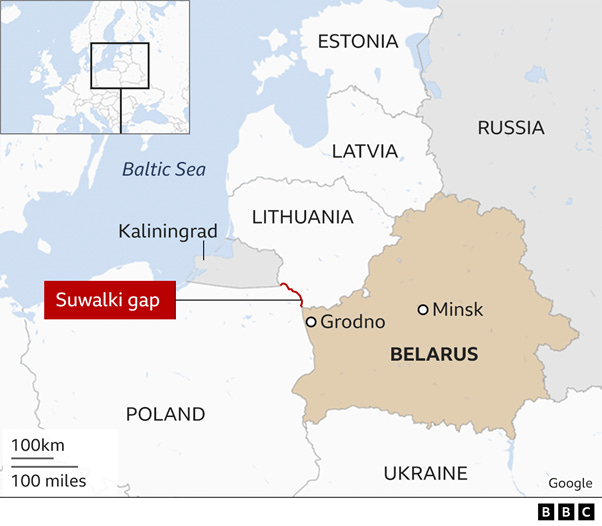
He insisted, in a nod to the debate about whether Russia might try a limited but direct assault against a NATO country, that Russia is not ‘threatening anyone’ and does ‘not intend to attack anyone in 2029, in 2030, in 2050.’ The risk of a nuclear war would come if Europeans attacked Russian territory. Here he singled out the enclave of Kaliningrad.
‘If it comes to direct attack on the Russian Federation, in this case, we mean Kaliningrad, maybe some other territories as well. Of course, naturally, immediately, what will be on the agenda is the use by the Russian Federation of all weapons that are at the disposal of our country. It is unavoidable.’
Kaliningrad has long been seen as a potential flashpoint for a NATO-Russia confrontation, but recently it has taken on new importance. It is in a region in which Russia’s position has weakened yet also one in which it keeps on trying to put on minor shows of strength to discourage Europeans from supporting Ukraine. In this post I’ll look at Kaliningrad’s shifting strategic significance and how it has become a key point of Russian vulnerability. Then I’ll consider whether rising tensions could spiral into something more dangerous.