
Understanding MAGA
This piece orginally appeared in the Times Literary Supplement and is reproduced with their permission. It’s a review of three new books about various elements of the the new right in the US, but I used the opportunity to sketch out the different roots of MAGA philosophy, such as it is, and to highlight the contradictions between them.
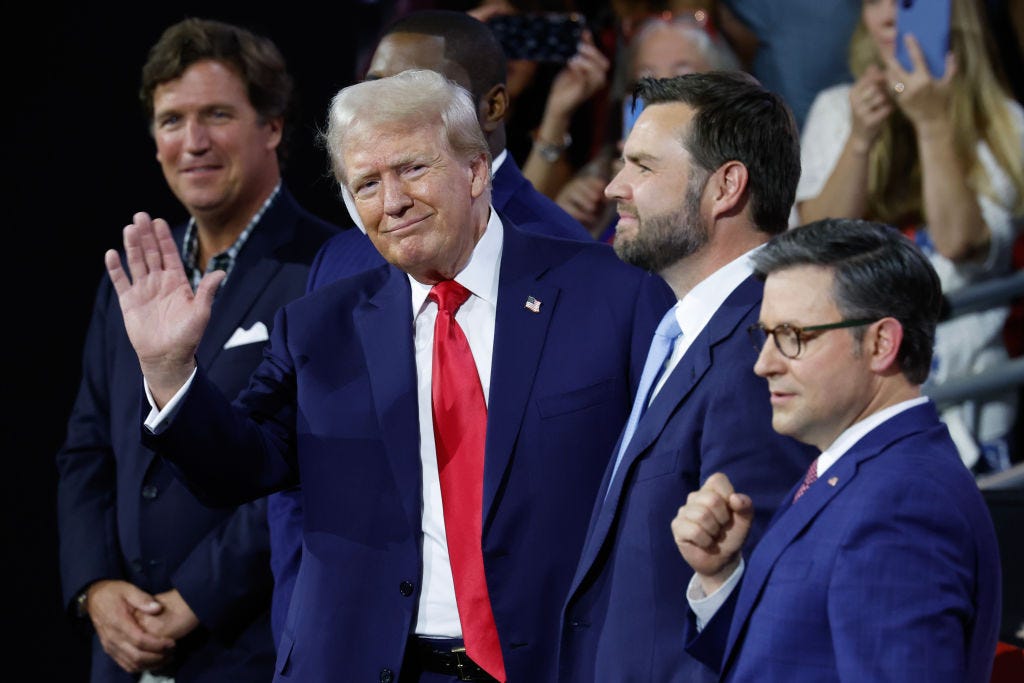
The rise of MAGA is arguably the most important political phenomenon of this century. Tracing its conceptual roots is critical to understanding where it came from and how best to manage the fallout. But it is challenging to analyse something that is so often aggressively anti-intellectual, revelling in its juvenile offensiveness. When confronted with a movement in which two of the leading lights call themselves Bronze Age Pervert and Raw Egg Nationalist, it is tempting to roll one’s eyes and wait for the nonsense to pass. That would be a mistake, though, because the messy and often contradictory set of ideas that make up Trumpism didn’t appear from nowhere and won’t evaporate when the president leaves the stage.
In Furious Minds: The making of the Maga new right, Laura K. Field identifies three distinct sets of thinkers: a group based at the Claremont Institute, focused on returning to the principles of the Founding Fathers; postliberals, who want less focus on individual rights and more on community; and national conservatives, who believe in the importance of the nation state over global governance.
The Claremonsters, as they like to call themselves, are the most intellectually interesting of the three. They are disciples of the hugely influential philosopher Leo Strauss (1899–1973), whose methodology involved close readings of “great books” such as Plato’s Republic or Machiavelli’s The Prince, based on the belief that they contain permanent truths that can be identified in a quasi-religious fashion. Strauss saw this as a way to counteract the relativism of liberal modernity. It is an approach that naturally appeals to conservatives of all stripes. Many of the neocons who clustered around George W. Bush and pushed for war with Iraq were also Straussians. “Great books” are handy for bolstering a range of ideological priors.
After Strauss died, his supporters split into an East Coast faction led by Allan Bloom at the University of Chicago and a West Coast one led by Harry Jaffa at Claremont College in California – an academic version of Biggie vs Tupac, with similar levels of bitterness. Jaffa’s school focused on activism rather than what it saw as the East Coast’s intellectual parlour games, and in particular on instilling the wisdom of the Founding Fathers back into modern politics. For adherents of this school, the founders’ version of the United States is close to the best possible regime, and thus any attempt to dilute it via liberalism is seen as disastrous.
This may all seem somewhat esoteric, except that seventy Claremont alumni hold or have held jobs in the current Trump administration. One of the best known is Michael Anton, who wrote the infamous National Security Strategy of 2025 claiming Europe to be facing “civilisational erasure” due to high levels of immigration. Anton has now left government, but he remains a powerful influence. His overwrought essay “The Flight 93 Election” (2016), in which he argued that a Democrat win would be the end of the US, was the first to make an intellectual case for a candidate whom many Republicans still opposed: “Yes, Trump is worse than imperfect. So what? … The alleged buffoon is … more prudent – more practically wise – than all of our wise-and-good who so bitterly oppose him”.
The postliberals considered by Field will be more familiar to British readers, who have their own troop of red Tories and blue Labourites bewailing the atomizing individualism of the modern world. For them, globalization and social liberalism have created an internationalist elite disconnected from ordinary “left behind” folk who are pining for communalism and traditional values. These analyses tend to ignore the existence of a large, young and ethnically diverse working class, preferring instead to focus on older, white former industrial towns. But they certainly tap into a genuine sense of loss and bewilderment.
As there is much overlap between conservative postliberalism and left-wing critiques of neoliberalism that also see individualism as an evil, it is the new right school that appeals most to Democrats (and to Labour MPs), particularly those representing those fading industrial towns. The most prominent American advocate for postliberalism, Patrick Deneen, got his big break when Barack Obama recommended his book Why Liberalism Failed (2018) on a summer reading list. This outlook also appeals to the religious, because implicit in the argument is the notion that the church provided the sense of belief and community now missing. In the US, it is particularly associated with Catholicism and “Catholic integrationists” such as Adrian Vermeule, a professor at Harvard Law School, who reject the separation of church and state, and argue that government should be based on spiritual values.
Then there are the national conservatives, a more loosely defined group built around a big annual conference who have helped to bring more traditional right-wingers into the Maga tent. These events are hosted by the Edmund Burke Foundation, currently chaired by Yoram Hazony, an Israeli American whose book The Virtue of Nationalism (2018) argues for the nation-state as a bulwark against imperialism in the form of international bodies such as the EU. Unsurprisingly, this is the part of Trumpworld that is most connected to radical right parties in Europe, in particular to Viktor Orbán’s Fidesz in Hungary. Orbán has spoken at several NatCon events.
All three groups share a deep hostility to immigration, whether as a threat to the US’s founding vision, to community or to the nation state. This hostility exposes the movement to what Field calls a “dark underbelly” of extremism – which is where Mr Pervert and Mr Nationalist come in – both, despite being palpably deranged, have wheedled their way onto the new-right podcast circuit to sell their visions of brute masculinity in a world apparently in thrall to the feeble “gynocracy”.
Initially, people such as Anton and Hazony made some effort to maintain a cordon sanitaire, however flimsy, against white supremacists and incels, but that has now largely collapsed, with many adhering to the admonition NEOTR: “no enemies on the right”. This stance is reflected in the more openly racist language and behaviour of the second Trump administration, with the president’s policy chief, Stephen Miller, leading the charge. The mastermind of the ICE raids that are still terrorizing US cities and a known fan of white supremacist websites, Miller is close to the Claremonsters and has been a regular speaker at NatCon events.
There is one other vital set that Field doesn’t discuss: the tech bros. Elon Musk and Peter Thiel get a few mentions in Furious Minds, but they, along with fellow travellers such as Marc Andreessen, arguably deserve their own category. Quinn Slobodian and Ben Tarnoff have a go at trying to define “Muskism” in a new book of that name. The authors don’t pretend that Musk himself has a coherent philosophy, but instead point to a set of behaviours via which tech utopians like him try to subvert the state for their higher purpose. Thiel is more explicit in his view that democracy has failed and that “extreme concentrations of power benefit humanity”. This can be seen in his patronage of the dismal Curtis Yarvin, a “thinker”, in the loosest sense of the term, who promotes dictatorship and dismisses the liberal order as a “cathedral” that needs to be destroyed. It’s an outlook that explains Thiel and Musk’s war against universities and government (which the latter attempted to gut via his DOGE initiative), as well as their obsession with the “woke mind virus”.
Unlike true libertarians, though, the tech accelerationists do not want government to disappear; rather, they wish to co-opt it through their companies. Thus SpaceX, thanks to a stream of lucrative defence contracts, has become indispensable to the Pentagon and Palantir has become an essential part of the surveillance state, informing ICE of potential targets. The vast expense of the tech bros’ utopian visions to conquer Mars and build cyborgs supplemented by superintelligent AI can only be met by steering the resources of the state towards them and, ideally, minimizing pesky costs such as welfare and education. At the heart of Musk’s world-view is, in his own words, the belief that empathy is “the fundamental weakness of civilisation”, because it delays progress towards his interplanetary paradise.
Of course, one problem with trying to analyse all these different strands of Trumpism is the man himself, who has no interest in Mars, Straussian close reading or Catholic integrationism. All the thinkers trying to find philosophical justifications for the president’s behaviour have to keep shifting position because his only real goals are power and personal enrichment. In “The Flight 93 Election”, Anton praised Trump for understanding the damage done by the “globalists’” trade deals and entanglements in foreign wars. Yet, though the president has imposed tariffs on other countries, he has been quite happy to sign up to deals with countries willing to remunerate his family (or give him a private jet). And any concern about “forever wars” in the Middle East has long been forgotten.
In some ways, this total lack of interest in consistency has held the MAGA coalition together. It is worth everyone trying to stay on Trump’s good side not only because of his gangster-boss demands for fealty, but also because he offers something for everyone and can often be persuaded to change his mind. Thus the tech bros keep supporting him, despite his tariffs harming their interests, because they can squeeze out other concessions. And the postliberals stick with him, despite his proclivity for foreign wars and tax breaks for the wealthy, because he is willing to sign executive orders condemning critical race theory and transgenderism.
The interesting question is where this will all go when he’s done. There is no chance of a return to old-school establishment Republicanism, but it’s also not clear that anyone else can contain the MAGA contradictions. If anyone can, it might be Trump’s most likely successor, J. D. Vance, who thinks of himself as an intellectual and is carefully positioned at the centre of all strands of new-right thought.
In Field’s book, Vance keeps popping up all over the place like an extremist Zelig. He gives talks at Claremont and helps senior alumni such as Anton and Russell Vought (who worked with Musk to gut the civil service as director of the Office of Management and Budget) into jobs. He is shown to be an admirer of Deneen, having converted to Catholicism in 2019, and has allied with Vermeule in arguing that the executive should have more power to assert its values over the judiciary. He is a regular speaker at NatCon events. And his Senate campaign was funded by Thiel, who once employed him as a hedge-fund manager.
Vance’s approach to managing the contradictions between these different schools is to barge through them with shameless hypocrisy. He condemns Europe for its “attacks on free speech” while attempting to shut down American universities for teaching opinions he dislikes. He sometimes pretends to care about the dangers of tech monopolies and corporate greed, while taking Thiel’s money and backing massive tax cuts for the rich. He is against pointless wars in the Middle East while defending those started by his boss, at least in public.
This tendency to play both sides was evident in Hillbilly Elegy (2016), the bestselling memoir that made Vance’s name. It was lauded as a paean to the forgotten Appalachian white working class; an explanation for Trump’s success. It is also full of cheap stereotypes and attacks on the citizens of Vance’s home town for their lack of gumption and reliance on the welfare state. It encompasses Deneen and Thiel at the same time. One could psychoanalyse this as the internal fight between guilt and pride at his having escaped his background to Yale and a career in hedge funds. Or it could just be that he is good at telling people what they want to hear.
Either way, Vance’s gamble is that a shared hatred of liberals is enough to prevent anyone on the new right from worrying too much about any of this. NEOTR is a powerful creed against a shared enemy and one he has been happy to support, for instance in defending one of Musk’s DOGE-ites, Marko Elez, when he was briefly fired for writing racist tweets. One of those posts said simply, “normalize Indian hate”. One wonders what Vance’s wife, Usha, whose parents emigrated from India, made of that.
The obvious problem with NEOTR, though, is that it means defending increasingly unsavoury characters as those on the fringes see how far they can go. Doing so drags the new right further away from an electorate who may not be liberals, but aren’t Nazis either. Exactly how far NEOTR extends is now an active conversation being had on the new right, following a softball interview of the neo-Nazi Nick Fuentes by the MAGA superstar Tucker Carlson in October 2025. And Fuentes really is a Nazi, having engaged in Holocaust denial and professed to being a fan of Hitler. Some MAGA supporters, including Ben Shapiro, have criticized Carlson, who remains a regular on the conference circuit and continues to interview administration figures on his show (aired on the Tucker Carlson Network). Trump, who used to be a big fan, but has more recently fallen out with him over Iran, defended Carlson over the Fuentes affair.
This put Vance in a tricky situation. He had previously criticized Fuentes for insulting his wife with a racial slur; and he has made pro forma statements that “antisemitism and all forms of ethnic hatred have no place in the conservative movement”, while also arguing against “self-defeating purity tests” and claiming: “we have far more important work to do than cancelling each other”. It is not clear, however, how these attempts to thread the needle will play with the true believers, leaving open the alarming possibility of an even more extreme candidate taking on Vance from the right for the next Republican nomination. Carlson might consider running himself. Jason Zengerle’s fair and balanced new biography, Hated by All the Right People, charts Carlson’s journey from being an intelligent conservative magazine writer to a Fox News populist, then on to the darker reaches of conspiracism after he was fired.
What makes Carlson interesting is not just his reach and overweening ambition, but the sense that he is a true believer. Throughout his career, he has been willing to compromise his views to a point, but less so than most. In Field’s typology, he fits best into the postliberal category – opposing foreign wars and willing to criticize corporate disdain for the working class. Unlike others, though, he hasn’t shifted position to accommodate wherever the Republican Party happens to be. He was one of the first conservatives to criticize the Iraq War and has continued to attack Trump for his Middle East escapades, while others have made excuses. His dislike of America’s support for Israel was one of the things that led him to interview Fuentes.
It also makes him dangerous, because he has even less interest in making concessions to mainstream opinion than do Trump or Vance, as was evident when he decided to interview Vladimir Putin in 2024, in a piece of television showmanship that was interspersed with promos for Russia supermarkets. Likewise, he is willing to embrace the worst figures from Field’s “dark underbelly” of the new right if they are prepared to support his views.
Carlson was a big supporter of Vance, having him on his show during his Senate campaign more than any other candidate, and persuading Trump to make him vice president ahead of Marco Rubio, whom he sees as an unrepentant neocon. They are still in touch, and Vance has continued to defend Carlson against accusations of antisemitism. But one wonders if Carlson thinks the vice president has made too many compromises and sees an opportunity to push the post-Trump Maga movement more in his direction.
Either way, the contradictions within the new right cannot be contained for ever. Whether liberals are in a position to take advantage of this brewing internecine battle remains to be seen. While the new right may be riven with obnoxious views and nonsensical arguments, it is at least home to a lively debate. Liberalism, by contrast, seems stuck between a defence of old norms and an acceptance that some criticisms are correct. For now, it is sustained by resistance to MAGA. But at some point it will need its own intellectual revolution worth writing about.
Thanks but I’m none the wiser.
Thank you for your thoughtful analysis. The American Civil War never ended. These attitudes underlie so much of what we see in the Far Right today. It’s the old hatred, resentment and prejudice wrapped up in a new, perhaps more sophisticated form. Sadly, this could mark the decline of the United States.