

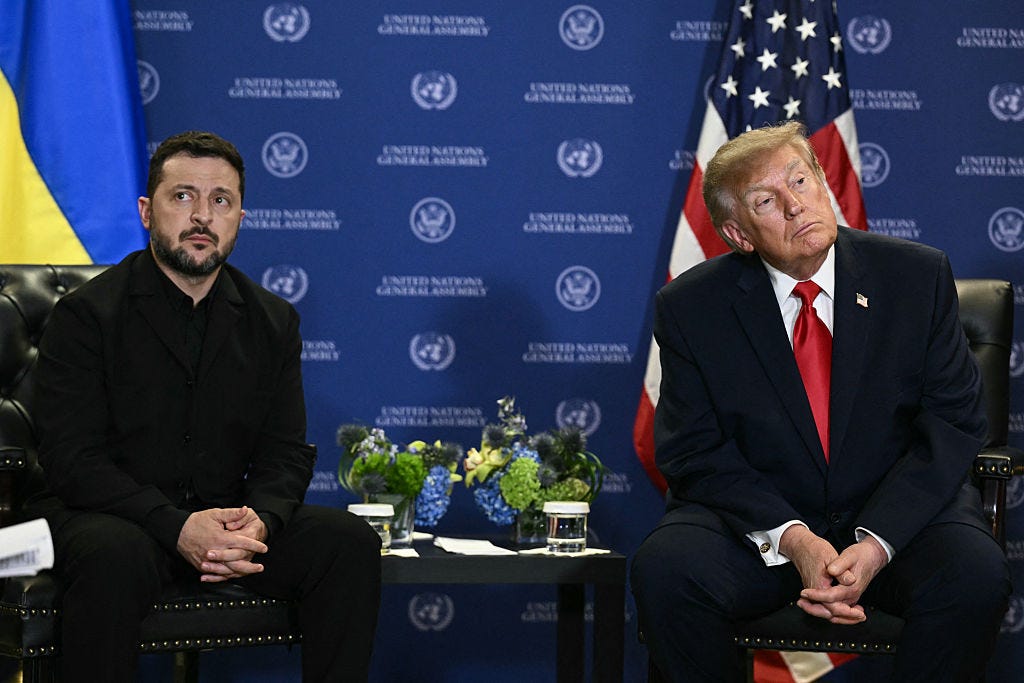
It would be so much better if we could address the challenge of defending Ukraine against Russian aggression without also having to deal with Donald Trump and the psychodramas surrounding him. But sadly that is not possible. We have been reminded over the past week that while Ukraine is far less dependent upon the United States than it was in January 2025, it still needs intelligence and capabilities that only the US can provide. The US is also the only country talking to the two sides about possible peace deals. Unfortunately, we have also been reminded of the president’s limited grasp of the realities of the conflict and who is responsible for the continuing violence, and also his erratic approach to policy-making.
Since the start of 2025, Volodymyr Zelenskyy has had to exercise superhuman restraint when faced with Trump’s victim-blaming, fabrications, and absurd demands. Recently, this restraint broke in the face of a series of provocations from the White House. These began with an agreement on 9 October with Russia to allow it to export diesel fuel, though this meant easing sanctions. Ukrainian complaints appeared to have backfired. There were the first reports on 14 October that Ukraine was being denied warning of incoming missile and drone attacks, and claims that the military version of Starlink was capped at 161 kilometres an hour in Ukraine, so that its interceptor drones could not catch Russian jet-powered attack drones. Then, on 16 October, Trump signed an executive order waiving the sanctions and tariffs due to take effect on 18 October under the new Graham Act, which he had signed into law.
As Zelenskyy expressed alarm, Trump said that it was time for Ukraine to get a new president. As Russian missiles and drones continued to strike Ukraine’s society and economy, causing multiple deaths, Trump stated that ‘Russia, frankly, has been fine on Ukraine. They haven’t been doing much.’
To Zelenskyy, this added up to a betrayal. He lamented:
‘It’s a pity that we’re losing a strong partner. When President Trump chooses one side, not our side. If you’re in the middle, you have to stay in the middle, not on the wrong side… I don’t know who pushed (Trump), but this is not the right side of history.’
All this made Trump angrier. All he was doing, he insisted, was trying to get a new peace deal.
Trump has, of course, spent much of this past year celebrating the imminent arrival of negotiating breakthroughs for any number of peace deals – mostly Iran – only for them to evaporate almost immediately or soon unravel. His announcements appear as wishful thinking rather than accurate reporting. And so it was when, in the middle of his spat with Zelenskyy, he suddenly announced on Truth Social an agreed ceasefire to spare energy installations:
‘Effective immediately, there is an ENERGY CEASEFIRE in the War between Russia and Ukraine. Both parties have agreed. Do not break it!’
This was news to both Moscow and Kyiv, but Zelenskyy accepted it while Putin deflected. When asked where this agreement had come from, Trump admitted that he had made it up. It was entirely in his head, which is where so many of his great diplomatic triumphs appear to occur.
Trump continued to imply that the main obstacle was Zelenskyy’s intransigence, as if he had a stake in a continuing war. All this was the opposite of the truth. Zelenskyy’s position on a ceasefire is far more aligned with Trump’s proposals than Putin’s. This was confirmed when Trump’s peripatetic envoy, Steve Witkoff, took a proposal to Moscow and was once again rebuffed, gaining no more than a readiness to reengage in trilateral talks with the Americans and Ukrainians. And even this came after Witkoff had told Putin directly that he was a ‘humanitarian’, a plaudit that the war criminal received with a straight face.
Trump’s combination of irritation with the aggrieved and sympathy for the aggressor is not new, but it has new elements. Trump’s cognitive abilities have deteriorated during his second term, and they were not great beforehand. This affects the credibility of his pronouncements, and, partly because of past experience, they are now received in a changed political context.
In this post, I’ll first consider what Trump is after, and why he is finding it increasingly difficult to get others to play his games. I will then briefly consider what is going on with the peace negotiations, before considering what this all means for Ukraine.