

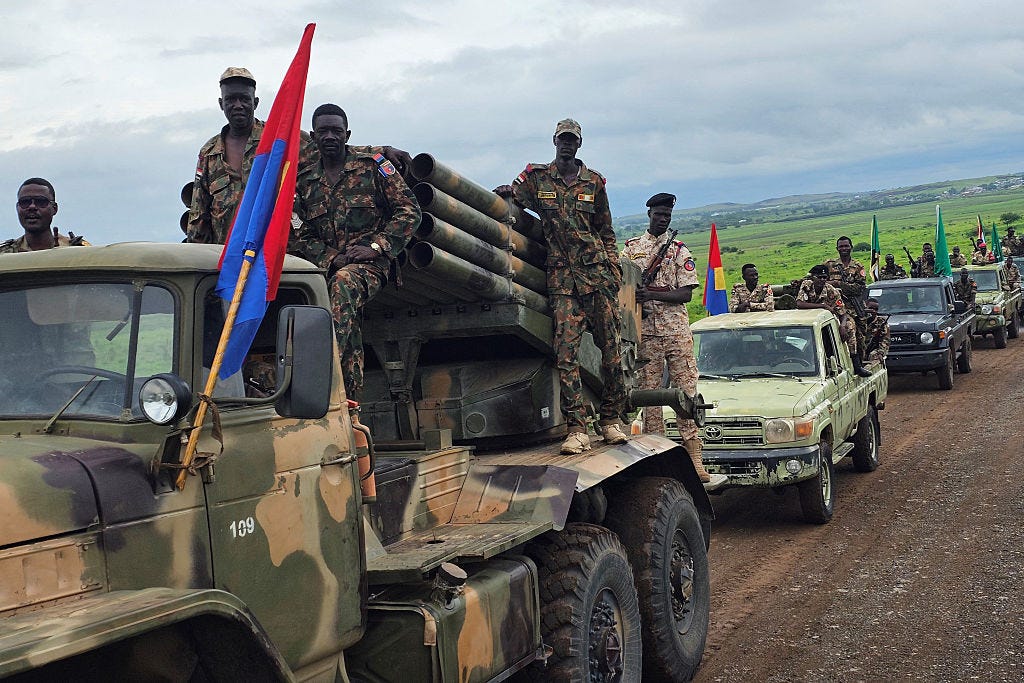
Since April 2023 Sudan has been consumed by a vicious war that gets far too little attention in the West. I am guilty of this. I described it in February 2024 as a ‘forgotten war’ and have only returned to it once since. One reason for the neglect can be explained by the demands made by the other big wars in Europe and the Middle East. That is my excuse. Another reason is the difficulty facing casual observers in trying to understand where this particular war comes from and why it continues.
What people do know is that Sudan is a humanitarian disaster on a scale that is hard to grasp. The exact number of deaths is impossible to know. A count from last April put the number at 59,000 but this is undoubtedly an underestimate, with the actual number two or three times higher or more. Over 11 million people have been displaced, of whom around 4 million have sought refuge outside the country. According to the World Food Programme, nearly 19.5 million people face high levels of acute food insecurity, of whom some 5 million face emergency or catastrophic hunger levels. Where battles rage people get trapped and aid cannot get to them. Farms have been destroyed and markets have stopped functioning. The warring parties often fail to allow humanitarian aid to get through as they see desperate conditions for civilians as a form of pressure on their opponents.
The WFP’s ability to get relief to these people has been further weakened by the cuts to aid by rich countries. The Iran War has made its own contribution with rising diesel prices and fertilizer shortages adding to the challenges facing farmers. Poor sanitation, a lack of vaccinations, and a badly damaged health system all contribute to the spread of deadly diseases.
The desperate need to get relief to those facing starvation and disease means that the war is viewed largely as a humanitarian catastrophe, as another African tragedy. But the tragedy has causes and these are political. The politics of Sudan at one level looks simple: a power struggle between the leaders of the national army and a very powerful militia. But look below and numerous other actors come into view, many smaller militias with their parochial interests, sometimes reflecting ethnic and religious identities but often largely economic. Then look beyond and regional powers loom large, funding the war and providing equipment, even as they discuss a possible peace.
So while the suffering caused by the conflict argues for a quick peace, its underlying complexity makes one harder to achieve. Compromises will always be elusive with wars, and especially civil wars, that have been underway for some time, without either side close to a decisive victory. They stir up deep emotions, of fear and hatred, triumph and solidarity. Blustery rhetoric demonises the enemy so that any concessions can easily be portrayed as a sellout and shameful. Continuing war may mean more pain for little gain but any deal reached through compromise may leave a sense of lingering dissatisfaction and unfinished business - creating the conditions for an eventual resumption of hostilities.
It often takes a third party - an international organisation or one or more major powers - to broker an agreement, but they can have their own interests in the outcome or else do not always stay around or do enough to ensure that any agreement is enforced. Peace-making may be a noble enterprise but it can frustrate all concerned. The deal-maker sees the benefits of peace lost because of foolish pride or unwarranted optimism about future victories. The belligerents see far too much trust being placed in the unreliable word of their enemies. When deals are made the results are often disappointing. Agreements can fall apart quite quickly so that fighting resumes. Even if they hold, in the aftermath of war life will still often be wretched and post-war reconstruction slow.
This is not an argument for not trying. When the alternative is continuing with the horrors of war then one does not want to be fatalistic about reaching agreements or dismissive of their potential value. Even an unsatisfactory peace will be an improvement on continuing bloodshed and offers opportunities for creating conditions that can give it some permanence. But it is an argument for realism and against taking up peace negotiations with exaggerated expectations. The challenge is always to shape a lasting peace that will not break down the first time it is tested.
When it comes to peace deals in civil wars there tend to be two options. The first is a power-sharing agreement which requires the warring parties to agree to govern together. This can hold the country together but requires that people with opposing world-views who have recently been trying to kill each other conjure up a productive harmony. The second is partition, which leaves the country divided, with opposing parties now having their own territory but not necessarily the wherewithal to govern effectively. There are variations on these themes, for example agreements which allow particular groups some autonomy within a still notionally unified country or governments drawn from figures not associated with either faction but potentially trusted by both. But when the end states are considered, power-sharing or partition tend to shape the possibilities.
Sudan provides tragic examples of the failure of both approaches and the general tension between the urge for peace and the ineffectuality of the peace-makers. When I last addressed the question of Sudan in September 2024 I quoted a UN report which noted that since independence in 1956, ‘more than 46 peace agreements have been signed,’ and that the weakness of the past efforts came from a ‘focus on ending the conflict without addressing the root causes or enforcing accountability for mass atrocities.’ The country’s history of horrendous violence includes two lengthy civil wars - between the majority Arab/Muslim north and the poorer Christian/animist south - plus the so-called ‘dirty war’ in Darfur. Millions have died or been displaced in these wars.
In this post I’ll consider the current situation in Sudan and the peace efforts underway. I’ll note how the logic of the situation, in terms of the territory controlled by Sudan’s army and the opposing paramilitary Rapid Support Forces, points to partition, even though this situation could well make a bad situation worse.
The Bad Situation
The origins of this war lie in the unsatisfactory conclusions of past wars and also the 30-year rule of President Omar al-Bashir who headed an authoritarian, Islamist, and deeply unpopular regime, responsible for much of the violence. He was overthrown in April 2019 by a combination of General Abdel Fattah al-Burhan, head of the Sudanese Armed Forces (SAF), and Mohamed Hamdan ‘Hemedti’ Dagalo, head of the Rapid Support Forces (RSF). The RSF had been sponsored by al-Bashir, for whom it performed disparate roles as he sought to control his unhappy country, until Hemedti decided that it was time for a change.
At first al-Burhan and Hemedti worked together to run the country and by the end of 2022 their plans for a return to civilian leadership and national elections seemed to be making progress. But warlords make for uneasy partners and tensions grew around the composition and role of the armed forces, and in particular how to integrate the RSF into the SAF’s chain of command and subordinate it to an elected government. The tensions eventually broke the partnership. The power struggle had tragic consequences as the two armies turned on each other. The fighting broke out on 15 April 2023 in the capital Khartoum, a city of 8 million people. But it soon moved beyond the question of who controlled the capital and spread throughout the country.
The fighting continues after well over three years. Although the RSF had control of Khartoum, causing more than half of the capital’s population to flee, it was pushed out in March 2025. The SAF now has the upper hand as it is largely in control of the east of the country. But the RSF is strong in Darfur to the west. El-Fasher, the regional capital, was under siege for 18 months. It fell to the RSF last October.
Military attention has since moved to North Kordofan, and in particular its capital, el-Obeid. The RSF made taking el-Obeid a priority and has sought to put it under siege, using drones to attack fuel, food, and water supplies. The SAF, however, recently has been having some military success in North Kordofan and now claims to be pushing the RSF back. According to the Sudan Tribune:
‘Through this sweeping western offensive, the military aims to advance toward Darfur along the ancient Darb al-Arbaeen (Forty Days Road). The rugged desert route has long served the RSF as a supply corridor for transporting fighters and military equipment from Darfur to the capital, Khartoum.’
So far the main response of the RSF has been to increase long-range drone attacks against el-Obeid and other government-held areas. But if it loses this current battle the SAF would be in a better position to threaten its stronghold in Darfur, just as an RSF victory would allow it to renew its threat to Khartoum.
The misery for civilians continues. A recent UN mission found that:
‘external support is sustaining military operations and expanding the capabilities of the parties to Sudan’s conflict, with grave consequences for civilians. Increasingly sophisticated drone capabilities enabled both parties to strike far beyond immediate front lines, yet greater technical capability did not bring greater civilian protection. The mission documented attacks affecting civilians, hospitals, schools, markets and displacement sites, including attacks that may amount to war crimes.’
The SAF has more legitimacy and has wider support from countries in the region, including Saudi Arabia and Egypt. The RSF is largely kept going by the United Arab Emirates (UAE). And while it is the case that both sides have been accused of atrocities, the RSF is the worst offender: it is feared inside Sudan for good reason.
The SAF does have some administrative experience and is more coherent than the RSF. Because it controls Khartoum it claims to be the true government. A recent description of life in the city from the Economist confirms how hard it is to return to normality. Some of those who had fled are returning but it is a desolate place. It is struggling to restore electricity and water supplies, and it is ‘littered with unexploded munitions’. According to the UN, ‘40,000 have so far been uncovered, but only 1% of the city has been safely cleared.’ It is very difficult to put a country together again while fighting continues. External benefactors do not want to pay to rebuild facilities only to see them destroyed again, while the SAF has to decide on what can be afforded on reconstruction while it still pays for war.
Getting to Peace
There are no direct negotiations underway between the SAF and the RSF. The body supposedly trying to get the parties to an agreement is known as the Quad, made up of America, Egypt, Saudi Arabia, and the UAE. A year ago, in September 2025, it proposed a sequence that would start with a three-month humanitarian truce, leading to a permanent ceasefire and then a nine-month process to construct a civilian government. Although at first the RSF showed some interest, the SAF rejected the proposed truce because it was confident that it had the advantage in the fighting. The US has tried to find ways to get the SAF to sign up, but al-Burhan demands that the RSF withdraws from the land it occupies, which is not going to happen voluntarily.
As the RSF’s main backer, the UAE has been urged to encourage it to become more compliant. But the UAE sees the RSF as a way of projecting its power into Africa, and countering Iran’s influence. A change in approach may be prompted by the fallout from America’s war with Iran, and now the Houthis’ growing power as they take more territory inside Yemen, pick fights with the Saudis, and threaten shipping through the Red Sea, which has been becoming more important as a transit route. So far this apparent shared interest in the Red Sea has not translated into a more cooperative approach. Other governments have urged the UAE to disassociate itself from a group associated with atrocities. The SAF has even been trying to open its own direct talks with the UAE, but this has been resisted as it would raise the status of the SAF to a de facto government.
Even if the UAE did start to explore a new deal it may not have the leverage assumed over the RSF. The group is still in a sufficiently strong position in Darfur to dismiss suggestions that it should capitulate. A recent assessment of ‘why Sudan’s humanitarian truces keep failing’ notes that ‘While the fighting in Sudan continues, experts believe that international diplomatic efforts to end the war are essentially dead.’ After some conversations around the recent UN General Assembly meetings, US Secretary of State Marco Rubio lamented that
‘We’ve had people agree to things, sign to things, and the commitments are never met … Every time it seems like we’re on the verge of making progress, one side or the other will back off because they think they’re winning or they think they could win.’
He also blamed external actors (he did not name names) for fuelling the conflict.
The logic of partition and its pitfalls
As the war came because of the failure of a nascent power sharing arrangement it is natural to look at the alternative - partition. This is especially so as it seems like one is taking shape naturally because of the clear territorial divide between the SAF in the east and the RSF in the west. Each has set up its own government in the territory it controls and their economies are starting to diverge.
But that does not make them coherent entities with any natural solidarity. There is no strong ethnic or ideological basis behind the division. Both forces, though especially the RSF, are coalitions of militias. There are estimated to be at least 150 different militias involved in the conflict, all with their own identities and issues, which are often about getting their hands on loot, and with limited commitment to the side with which they happen to be associated at any given time. They are apt to switch sides when promised more money or territory. On the SAF side there are groups who once fought each other in Darfur. The oil producing areas are to the west; the refineries, pipelines and ports are to the east.
There is already an example of how badly partition can turn out with the case of South Sudan, which became an independent state in 2011, following the second Sudan Civil War. There is a cautionary and sobering article in Foreign Affairs by Francis M. Deng and Ahmed Kodouda which shows how grievances previously expressed about the rest of Sudan—such as disputes over cattle grazing rights, control over oil-producing areas, and competition over government positions and patronage—were exposed, not resolved, by southern independence. The political elites that had led the campaign for liberation turned on each other. A power struggle at the top between President Salva Kiir and his vice president, Riek Machar, erupted in late 2015 into a civil war. By 2020 some 400,000 people had been killed and more than four million displaced.
They report how South Sudan became ‘a poster child for kleptocracy’;
‘The Sudan People’s Liberation Movement, the rebel group that carried the banner of southern liberation and later became South Sudan’s ruling party, turned out to be far more adept at waging war than nation building. The oil wealth that accounts for approximately 98 percent of government revenues was systematically funneled into patronage networks and private accounts rather than infrastructure, education, or health care.’
The respite provided by a 2018 peace deal ended in March 2025, when Nuer militia backing Machar overran a South Sudanese army base near the Ethiopian border. Machar and dozens of senior opposition figures were arrested. The fighting got so bad that of the nearly 300,000 civilians who fled the country in 2025, about half went into Sudan, despite its own war.
They draw the lesson:
‘South Sudan’s trajectory demonstrates that partition resolves nothing as long as the state is treated as a prize to be captured and hoarded, rather than an institution to serve its citizens.’
South Sudan started with substantial international assistance and still fell short. The two individual parts of a partitioned Sudan would get far less. An RSF-controlled Western Sudan would be landlocked and while it would have oil to export it would only be able to do so through the rump Sudan. In these conditions the illicit economy that already keeps it going now would flourish, meaning that there would be little available for reconstruction, even assuming the RSF were interested. The prospects would be better for the rest of Sudan run by the SAF but they would have lost access to much resource wealth and would still face the prospect of insurgencies and internal strife. As with all partitions, however neat it might look on a map, many communities on one side would not fit naturally and would face subjugation and marginalisation.
Deng and Kodouda conclude:
‘Any cease-fire that freezes and calcifies the current conflict lines would do very little to address underlying political, economic, and social grievances. It would simply provide a new framework in which armed actors could continue to try to advance parochial objectives, such as seizing farmland, controlling gold deposits, or settling tribal beefs. Drawing a line through Kordofan would create two weak states, each riddled with internal divisions and hostile populations and lacking the economic foundations for recovery. And each would continue to have powerful incentives to destabilize the other, teeing up fragmented, localized, never-ending conflicts and killing the chance, however remote it may now be, for a negotiated national settlement’
A partitioned Sudan would also disrupt South Sudan because it needs the pipelines running through SAF and RSF territory to get its oil out and risks being destabilised further if the conflict between the two entities continued in a different form.
They do not argue for power sharing between al-Burhan and Hemedti. This has already failed catastrophically, and one reason for that was the focus on the relations between two armed forces. Instead they propose addressing the humanitarian situation while establishing a
‘political process that engages all the parties, with culturally oriented national reconciliation processes and accountability for the egregious crimes committed by all sides.’
At the moment, however, it is hard enough to get any peace never mind a good peace. The humanitarian imperatives argue for an early ceasefire. Most commentators agree that requires a concerted effort by the regional powers to put their differences to one side and use all their leverage to get the warring parties to engage. As the Economist put it:
‘America and Europe should lean on their Gulf allies to press the belligerents they support to talk directly to each other for the first time. Saudi Arabia, Egypt and Turkey should urge the SAF to stop insisting the RSF disarm and demobilise before negotiations can begin. The UAE should use its influence over the RSF to hold it to its professed desire for a ceasefire—even if that means abandoning the ambition to rule all of Sudan.’
But even if that were sufficient to get a truce that would allow aid to reach those most in need it would leave the SAF and RSF in charge of their respective territories. The SAF has shown no interest in partition and wants a unified country with a central government. But they might also worry that it will always be a challenge to control Darfur and they have allies who might not be too concerned by its loss. The RSF will want to keep control of their territorial base.
A move from the chaos and carnage of war to a desirable and sustainable end state involves at least a two-stage process, with first a ceasefire and then a long-term settlement. But it is rarely straightforward to move from one stage to the next. The first requires the agreement of the warring parties. The second requires the warring parties to either change their behaviour and attitudes or else allow new actors to come in and establish their authority. The new actors need to be civilians, with a focus on reconciliation and reconstruction, but as civilians they don’t have the guns and will always have to keep an eye on those who do. If getting to stage two proves to be too difficult and negotiations drag on then the ceasefire lines will calcify and turn into de facto borders. It is hard to turn a ‘peace at last’ into a ‘lasting peace.’
God this is unutterably depressing - but thank you for such a clear exposition of the situation. It's difficult to hold out much hope for the ordinary citizen of Sudan wanting a peaceful life.
This is really good, thank you, Professor.