
The Split-Screen War
Finding a way out of a war gone badly wrong

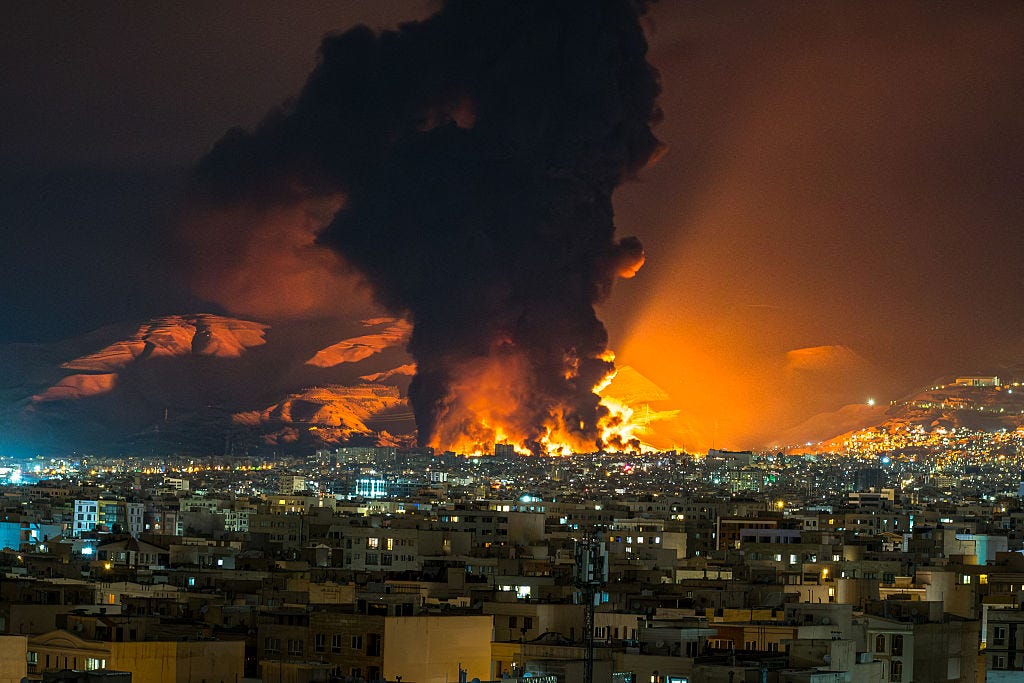
Two weeks on and the basic structure of the Iran War has not changed much from the first day. On one screen Israel and US have command of the skies over Iran and can hit targets at will. Their hopes that this would cause the Iranian regime to collapse have thus far failed to materialise. This is in part because their command of the air is not matched by any presence on the ground.
On another screen barrages of missiles and drones are threatening states who had no interest in joining this war but now find their air defences being constantly tested. Oil and gas production is at risk and what can be produced can’t get out. It has become too dangerous to pass through the Strait of Hormuz, the vital but narrow sea passage out of the Gulf. While this goes on both the regional economy and the whole international economy are, in effect, being held hostage. In terms of the immediate outcomes of this war what goes on in this second screen is the most important.
It is this feature of the war that highlights the key difference between the two sides. Iran knew what might be coming and had prepared accordingly. It had a strategy, with regime survival at its core, which involved plans to replace those in the leadership group who had been assassinated, suppression of any anti-regime forces within the country, and generation of sufficient mayhem in the region to create a form of counter-coercion that would put pressure on its enemies. So far it has executed this strategy effectively. It has survived and the Trump administration seems now to be under more pressure than the Islamic Republic to find a way to end this war.
The United States and Israel did not start the war with a clear strategy. There was a hubristic assumption that if the adversary was hit badly enough that it would either collapse or surrender. President Trump keeps on insisting that the US has already won and that the only issue is the refusal of the regime to recognise that fact. When asked what he meant by ‘unconditional surrender’ he defined it as when
‘they cry uncle, or when they can’t fight any longer and there’s nobody around to cry uncle – that could happen too!’
Meanwhile the developing international economic crisis is played down with promises that it won’t last long and help is on its way. The overall impression is one of disarray and confusion, as if, as I suggested last week, the administration is making it up as it goes along. The administration vigorously denies suggestions that it had not considered the vulnerability of the Strait of Hormuz in its pre-war planning, but that just begs the question that if they were aware of the issue why were they not better prepared to deal with it. The best answer is that they did not think it would matter because the enemy would not last long - the classic short war fallacy that when it does not work out is so often a prelude to longer and more complicated wars.
I would not draw the conclusion from this that the Islamic Republic is ‘winning’. The regime rests on weak foundations and while it can hold on to power by keeping the lid on popular discontent, their miliary assets are being degraded and the country could become progressively ungovernable. There is a Gotterdammerung element to its strategy - if they cannot survive then they are going to take everyone else with them. If that is how the most ideologically fervent view the situation, for those whose interest is genuinely regime survival then their best approach is to use the chaos they’re creating to find a way out sooner rather than later. In the rest of this post I’ll consider how the Americans got into this mess and their options for getting out; what Iran can do with the leverage it’s acquired; and what a negotiation might look like.
Keep reading with a 7-day free trial
Subscribe to Comment is Freed to keep reading this post and get 7 days of free access to the full post archives.