
Back in 2022 I wrote about the long-term prospects for undoing Brexit and made two predictions. First, that public opinion would shift towards rejoining, driven by demographic change and growing regret amongst Leave voters. Secondly, that internal Labour politics would force the question of our long-term relationship with Europe back to the surface.
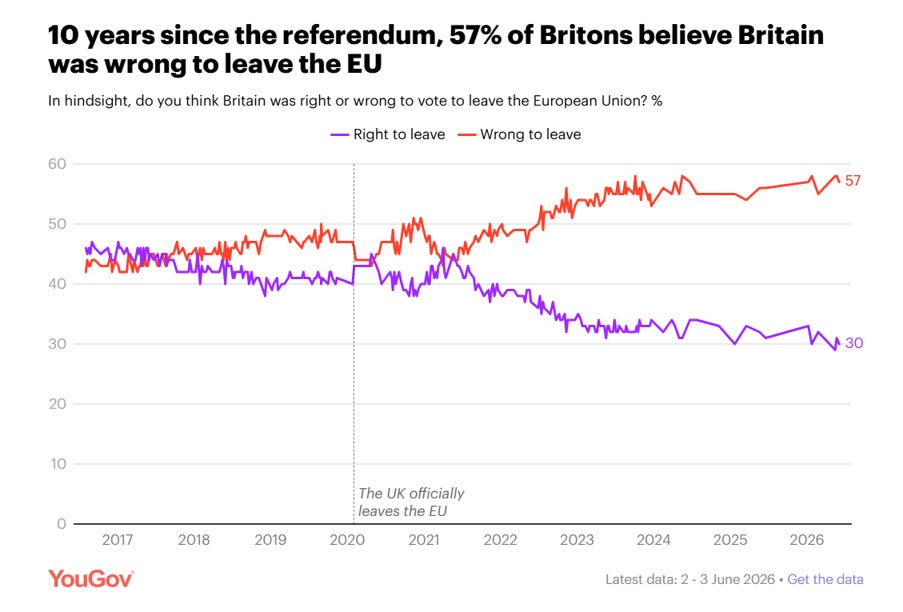
Both have happened. The number who think it was right to leave has continued to fall as shown by the YouGov tracker below. When asked about “rejoining”, voters now back the idea by 27 points over staying out, up from 15 points in January 2024. The number of Leave voters backing “rejoin” has gone from 16% to 27%. Younger people who have joined the electorate since 2016 are strongly in favour.
Labour’s position has shifted too. In 2022 we had only recently left and Keir Starmer did not want to talk about Brexit at all for fear of alienating Leave voters. His 2024 manifesto ruled out a customs union or joining the single market, let alone full membership. This strategy was never going to hold in a party dominated by Remain voters and which is now seeking to win back progressive defectors. Almost anyone still strongly committed to Brexit will vote Reform or Conservative anyway, so there is little to lose from shifting position, and potentially much to gain. Polling suggests a strong manifesto commitment on the EU could add four to seven points to Labour’s vote percentage.
Thus Andy Burnham’s decision to open the door for such a commitment in his conference speech. The relatively muted reaction from the Tories and Reform tells us they know how unpopular Brexit has become, and that they do not want to spend time on the issue. Voters on the right, particularly Tory voters, are much more split on Brexit than those on the centre and left. Last weekend’s Opinium poll found current Conservative voters actually supported Burnham’s pledge to consider all options for a closer relationship by 46%-38%.
But, of course, there is a long road from raising the prospect to making it happen. Sceptics are quick to remind us that public opinion could change quickly, especially once the downsides of a prospective deal are known. The EU has shifted direction since we left, and key member countries are facing serious political difficulties of their own. Any negotiation would be difficult.
All this is true. Yet, there is a route if Burnham wants to go for it. For both sides, geopolitical shifts mean there is arguably even more reason for the UK to be a member now than there was a decade ago. And the EU is perfectly capable of being pragmatic when it is in the interests of member states.
So in the rest of the post I will look at each step of the sequence and what has to happen to make it work, as well as the most important barriers. We’ll start with the path to a manifesto pledge, then the prospective negotiation, and finally with the challenges of another referendum.