

We have a guest post today from Rob Blackie. He was the 2024 Liberal Democrat candidate for Mayor of London, achieving their best result in 16 years. Rob also founded the “Breaking Putin’s Censorship” campaign which uses digital advertising to show real news about the war in Ukraine to Russians.
In his professional life Rob advises startup deep technology companies on how to explain their science to investors. Prior to founding his own consultancy, Rob headed up Social at OgilvyOne UK and was Head of Global Social Products at Ogilvy. Before that he was MD of Blue State Digital’s EMEA.
Buried in our national crime statistics, is this astonishing fact: 27% of women have been sexually assaulted since their 16th birthday, and roughly one third of these assaults are rapes or attempted rapes.
There is remarkably little public discussion of these crimes even though they are common and serious. They are unpleasant, so most of us are instinctively uncomfortable discussing them. As a small mark of this silence, Parliament discusses sexual violence roughly as often as it discusses theft.
When I stood for Mayor of London last year, women’s charities told me that this unwillingness to talk about sexual offences is a significant challenge. Politicians didn’t want to discuss the problem, let alone devoting money and effort to finding solutions.
It’s hard to solve a problem if you don’t acknowledge it.
Maybe this is because many people assume that in a world of increasing equality, sexual assaults are a problem of the past, a problem that is getting less serious over time. However, that’s wrong.
Official data shows that not only are sexual assaults a widespread and serious problem, but also that there has been no significant improvement in recent years.
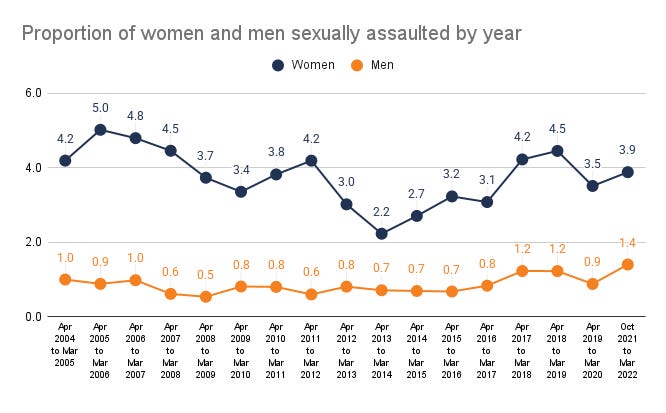
Source: Crime Survey of England and Wales. The latest data is for 2022.
We have good data, going back to 2004. In the last 20 years there has been no fall in the frequency of sexual assaults. In any given year roughly 4% of women are sexually assaulted. It is unsurprising that Yougov find that two thirds of women sometimes feel unsafe walking home at night.
For everything from burglaries to car theft and overall violence, we’ve seen large falls in crime since the early 1980s. But not for sexual violence. Something is broken.
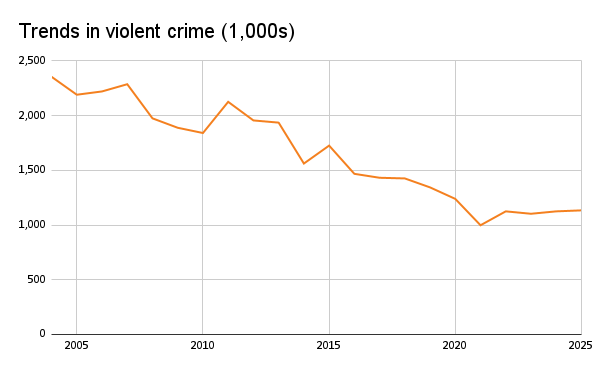
Source: Crime Survey of England and Wales.
How to cut sexual offences
So what can we do about it?
Inevitably at this point, conversations turn to culture change. For instance how do we encourage men to be active bystanders who discourage or divert other men from negative behaviours? Education and changing culture is a good idea. But it is far too slow - because most of it is delivered through schooling, and widespread attitude change often take decades. We have opportunities to cut sexual offences significantly in the next few years.
There is now a lot of good evidence on how to do so. Britain has Operation Soteria, a groundbreaking collaboration between academics and the police, which has gathered valuable evidence on what needs to be done.
