
"The Kremlin faces some very difficult choices later this year"
An interview with Dr. Jack Watling

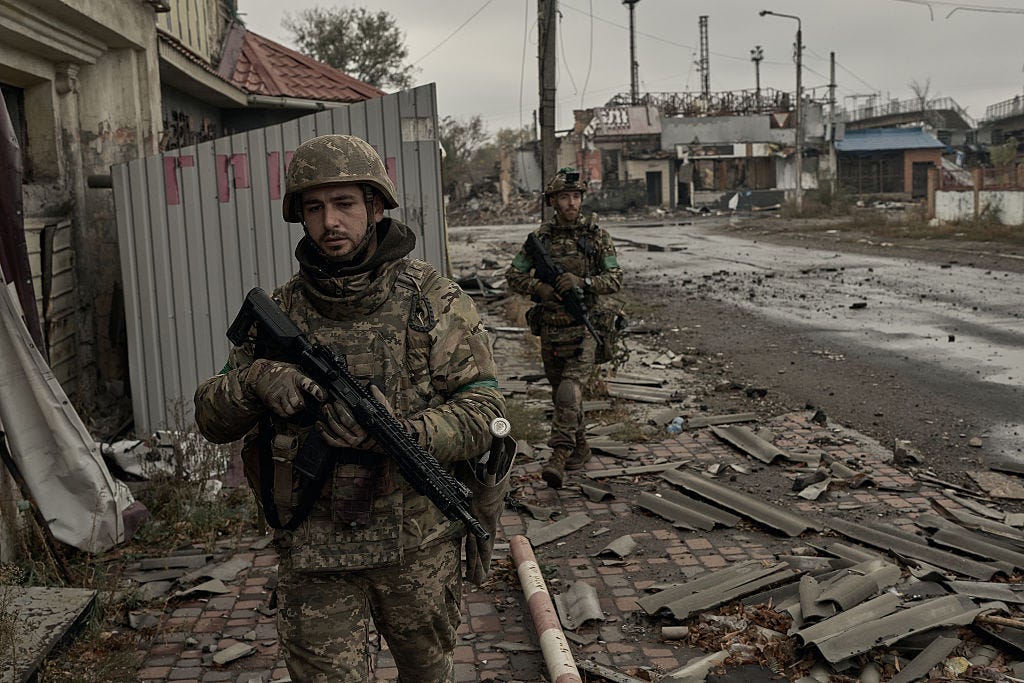
Today’s post is an interview with Jack Watling who was in Ukraine just before the full-scale invasion and has been back many times since where he has got to know many key military figures. He is now recognised as one of the most authoritative commentators on the war and developments at the front line. Jack recently published Statecraft: The New Rules of Power in a Divided World, which contains not only some fascinating accounts of the Russo-Ukraine War but also observations drawn from many other conflict zones, including in the Middle East and Africa.
Jack is a Senior Research Fellow for Applied Military Sciences at the Royal United Services Institute. He works closely with the British military on the development of concepts of operation, assessments of the future operating environment, and conducts operational analysis of contemporary conflicts.
He has worked extensively with the Ukrainian Armed Forces during Russia’s full-scale invasion, across NATO, and in Iraq, Mali, Rwanda, on Yemen and further afield.
Lawrence: You open the book with you in Ukraine days before the full-scale invasion. It’s a poignant story, because you’re convinced that the war is coming and the Ukrainians are not, until almost the last minute they realize this is for real. You give the explanations for their scepticism. Not all intelligence agencies agreed with the Americans and British. It seemed a foolish thing for the Russians to do, which was my view at the time as well. If they were going to do it, there were other ways of doing it, perhaps concentrating on the Donbas, and so on. What was the key thing that made them realize, actually, this was serious?
Jack: There had always been people in the Ukrainian system who did share our view, but they were a minority at a senior level. The assessment changed at the point where the Russians received their orders. Once the Russian units were told this is what you are going to do, and started to pack up their equipment and get ready, the Ukrainians had to take it very seriously. But you’re talking about 72 hours before, and even then Zelenskyy personally was not immediately convinced. So really you’re talking about 48 hours of decision time.
Lawrence: They did quite a bit in that 48 hours.
Jack: Absolutely. Firstly, the Ukrainians had been at war for eight years, and they had a lot of military capacity and a lot of reserves, including reservists who were not committed. There was a lot of latent potential, which they were able to draw upon. The second thing is that their own military assessment was that the Russian forces were inadequate in size for the task they had been given, which was correct. The third thing is that the Russians performed so badly that they gave the Ukrainians time to mobilize. They wouldn’t have had to have been much faster to overrun the process of mobilization in parts north of Kyiv. It was much closer than some people like to think.
I’ll give you an example. Whether the Russians made it through Mykolaiv and into Odesa came down to whether a Russian brigade was prepared to attack across a causeway, and they were en route to do it. The Ukrainian force defending that causeway was 15 people, which the Russians didn’t know. The Ukrainians dispersed across the village and started talking on their radios about where they were going to deploy the Javelin teams, and the Russians were listening to this communication, and stopped because they thought that there were 30 or so Javelin teams in front of them. There weren’t any. But just the fact that the Russians slowed down meant that all of a sudden there was 24 hours in which the population could mobilize, equipment could be moved south. The numbers started to change.
There was one Ukrainian air defence unit that found itself on the wrong side of the front lines and drove out of its base and actually ended up driving alongside a Russian column for a period of time, asking them for spare tires at one point, then drove across the front line, set up, and started to engage Russian aircraft. So, Russian execution let them down.
Lawrence: You discuss a number of times in the book how the Russians don’t make the most of their advantages, such as with the attacks on critical infrastructure. They don’t quite follow through with as sustained and directed a campaign as much as they could have done.
Keep reading with a 7-day free trial
Subscribe to Comment is Freed to keep reading this post and get 7 days of free access to the full post archives.