
According to every measure we have adolescents and young adults have become significantly more anxious and depressed over the last thirty years. This is true regardless of gender, family income, sexuality or ethnicity. It is a global phenomenon affecting every rich country, though it is hard to compare the degree of change across nations due to differences in data collection. For the first time this group is exhibiting more anxiety than people in middle age, who typically have many more responsibilities to worry about.
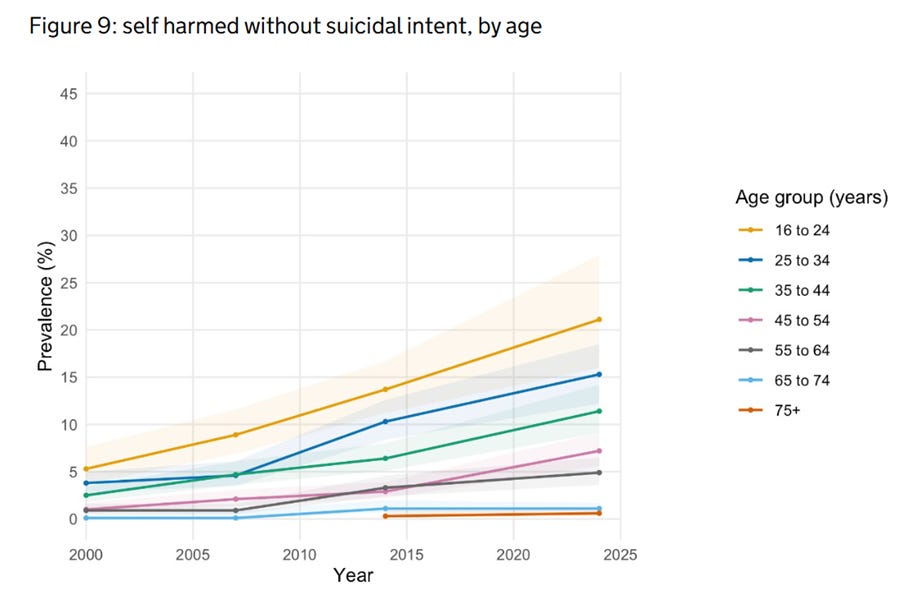
Despite widespread scepticism, this is a genuine trend and not simply due to higher levels of recognition, reporting or excessive sensitivity. Young people are not just talking about experiencing more psychological distress but acting on it. The number of 16-24 year olds who say they have self-harmed has quadrupled since 2000 (see chart below). NHS admissions data on self-harm confirms large increases, including a 148% increase for 10-14 years olds between 2011 and 2021. We also saw a 90% rise in under-18s admitted for eating disorders, between 2015/16 and 2020/21.
We have not seen notable increases in young people with bipolar or psychotic disorders. This is not a general worsening of all mental health conditions, but specifically a problem with anxiety and depression. We are also not seeing worse behaviour: prevalence of smoking, drug-taking, and criminality have all fallen substantially over the same period. As a recent Department for Health review puts it: “the current pattern is more one of rising internalising distress - anxiety, low mood, worry and social strain - than of generalised behavioural deterioration.”
One consequence of this anxiety is more difficulty establishing relationships. The number of 16-21 year olds with three or more close friends has fallen from 85% to 72% in a decade. There has also been a similar decline in the proportion of 14 and 15 year olds happy with their friendships. This in turn increases anxiety and depression.
We have also seen a rise in young people not working due to poor mental health, a shift that has driven much of the policy response as it leads to higher welfare costs. The numbers of 18-24 year olds out of the labour market for health reasons rose from 94,000 to 185,000 between 2012 and 2022. Again, this has a causal effect in both directions, being out of work often worsens mental health and leads to less social contact.
For those that accept this is a real trend there are plenty of potential culprits from austerity to school exams. But in the last few years most of the focus has been on social media, culminating in the ban for under-16s due to come in next spring. While more regulation is justified, there is a risk that we pile all the responsibility on technology and think we have solved the problem. In reality it is a lot more complex and fixing it will require going beyond the usual policy approaches.