
Ten quick wins for Labour

A few weeks ago I was doing a talk to a group of headteachers, running through each of the big challenges a new Labour government will have to deal with – from increases in child poverty, to the collapse of local government, and a broken special needs system. I was doing my best to be optimistic, setting out possible solutions for each of these problems, while acknowledging the fiscal constraints.
But then, in the Q+A, one head said: “for every one of these problems you’re saying it will take a decade to solve it. I can’t wait a decade. Please give me some hope for now”.
It’s a hard question to answer but one Labour need to be thinking about. The list of problems they’ll inherit is so long, with each being so hard to solve. There is a risk they will simply be overwhelmed. The public will allow them a grace period but it will be, at most a couple of years, and possibly a lot less. Their emerging policy agenda is not short of ambition but it focuses on issues like planning and devolution where change will inevitably be slow.
So I’ve come up with a list of things they can do in their first few months that would change peoples’ lives for the better straight away. My self-imposed rules were that proposals:
Must not require primary legislation
Must have an immediate effect (i.e. not be a review or enquiry)
Must be easy to implement (i.e. not require setting up a new organisation or involve allocating money that won’t be spent for years)
I’m also conscious of the financial situation so as a package it is cost neutral. Only three of the suggestions involve spending and another one brings in enough money to pay for them.
Obviously sticking to these rules means excluding lots of things that need to be done – ultimately Labour will only be successful if they are willing to take on at least some of the difficult and messy problems that have dogged Britain for decades. They’ll be plenty more posts on those issues over the coming months. But for now let’s focus on some quicker wins that can offer some hope. Please add your own suggestions in the comments!
1. Scrap the two child limit
This is the most expensive one – costing £2.5 billion in the first year and rising to £3 billion by the end of the Parliament. But it is also the biggest no brainer. Official statistics published this month show that there are now 4.3 million children in relative poverty, the highest ever, with record rises in absolute poverty, food bank use, and families not having enough to eat. This is catastrophic for those people but also for public services (see for instance the big increase in school truancy) and local government who have to cover the cost of acute services for children in care.
The two child limit, which means benefits are not paid for more than two children with only a few exceptions, is a policy laser targeted at increasing the numbers in poverty. It hits those already most at risk, of which almost half are single parent families. It now affects over 400k households containing around 1.5 million children. You can see from this Resolution Foundation chart the direct impact of the policy on poverty rates for bigger families.
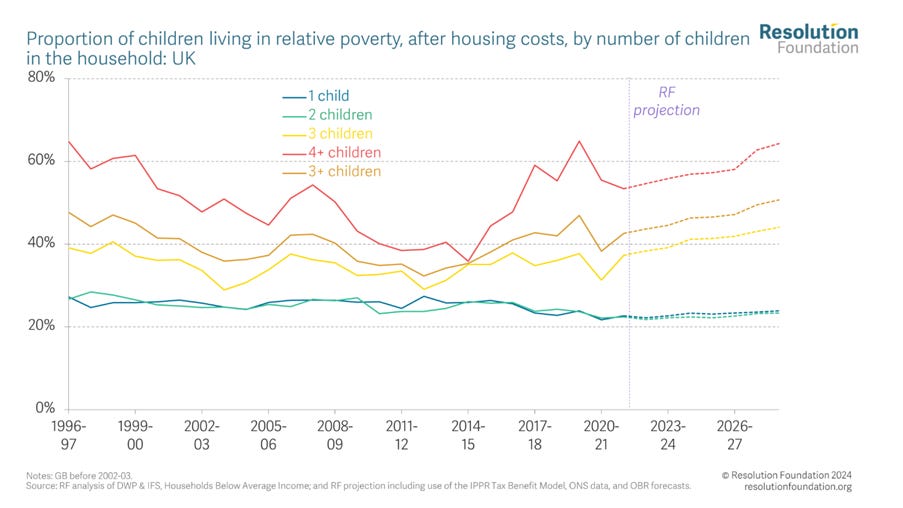
Labour have refused to commit to removing the limit, because of the, partly self-imposed, fiscal constraints they’re operating under, but also because they know the policy still has considerable public support. Many people, often struggling financially themselves, are not keen to pay out to those who have children without the means to support them. There would be a round of “soft on scroungers” stories. But that cost would be very significantly outweighed in the short to medium term by the positive news about record drops in child poverty, and by taking pressure off public services, who will not be getting much additional cash.1
2. Allow councils to keep “right to buy” money
In my post on the decline of social housing I praised the government for finally allowing councils to keep 100% of the receipts when existing homes were sold via “right to buy”. With the money having to be spent on replacement housing. Had this policy been in place since the start of “right to buy” in 1980 we would be in a much better position now.
Unfortunately I spoke too soon. The policy was only temporary and in the budget Jeremy Hunt reversed it for 2024/25 onwards. This saved him £200 million a year for his tax cuts but will further reduce availability of social housing. Which has – along with wider problems with the planning and benefits systems – already led to a shocking rise in homelessness and families living in temporary accommodation.
Labour have big ambitions on housing, which will take time and political capital to implement. But they could immediately signal intent by reversing Hunt’s decision. It would provide councils with a bit more money but, perhaps, more importantly, show them that Labour was genuine in their determination to tackle the problem.
3. Scrap tuition fees for teacher training
Severe teacher shortages are one of the many problems that would be getting much more attention if so many other things weren’t falling apart at the same time. Last year the system was able to recruit only half the target number of secondary teachers. This year numbers are looking marginally better, largely because of a concerted effort to encourage applications from outside Europe. 57% of those accepted on to physics teaching courses so far this year are international students – which is not sustainable. Meanwhile primary teacher targets are on track to be missed by the widest margin ever.
Longer-term Labour will hope we get enough economic growth to allow for proper increases in public sector pay. Teaching is hardly the only area with serious shortages. But that is going to be expensive. As an immediate fix they could cover tuition fees for teacher training at a cost of around £100 million a year, and remove one of the main barriers to people signing up.2 It could be done on a temporary basis to assess the effect and, if it works, could be applied to other professions like nursing. It would both ameliorate a serious problem facing schools and give those working in education a signal their problems were being taken seriously.
4. Void the Rwanda deal contract and start processing asylum seekers again
The first three suggestions involved spending money so here’s one that pays for them all and immediately changes a lot of peoples’ lives for the better. By the election, under the terms of the agreement signed with Rwanda, we will have already handed over £270 million even if not a single person has been sent there. Surely one of the worst deals in British history.
A new government can, however, implement a break clause, straight away, that would save £100 million split over the following two years. Depending on whether the Conservatives are able to run any flights over the summer they may also be able to avoid a £120 million additional fee triggered after 300 asylum seekers are relocated. Plus further costs of £150k-£200k per asylum seeker for relocation and travel.
But there’s an even bigger saving available. The appalling Illegal Migration Act places a duty on the Home Secretary to refuse asylum to anyone who arrived after 7th March 2023 if they came via a safe country. Which means their claims are not being processed even though there is nowhere, in practice, to send them. As of December 2023 there were 55k people stuck in the system, by the time of the election it will be close to 100,000, mostly in hotels. Based on previous Home Office figures this will be costing around £5 billion a year. And asylum seekers aren’t allowed to work, except in exceptional circumstances. It’s an astonishing waste of both money and human potential for no benefit whatsoever, as there’s no deterrent effect.
There is a clause in the Act that allows the Home Secretary to offer asylum if they “consider that failure to do so would contravene the United Kingdom’s obligations under the Human Rights Convention or any other international agreement to which the United Kingdom is a part” – which is an easy get out while Labour figures out a more comprehensive overhaul of immigration legislation.
They can get on with processing, save a fortune, and make a virtue out of it. It’s clear from surveys and focus groups that the use and cost of hotels is one of voters’ main concerns about asylum, so Labour should pledge to halve the numbers in a year and save £2.5 billion, within two years they could be saving £4 billion. Unlike a “stop the boats” promise it would actually be achievable and in everyone’s interests.
5. Index link tuition fees and maintenance grants
The mess that is university finances has finally started to get more widely noticed after a series of institutions announced big cuts and redundancies. This is not a problem to which there is a quick fix, especially if Labour choose not to reverse changes to migration rules that allowed international students to bring family members with them. But either way total reliance on a shaky international market is never going to be sustainable. Labour will have to find a way to boost domestic income.
Given the extremely tricky politics – and understandable opposition to further fee increases – I suspect they will send this one off for a lengthy review under a committee of the great and good (again). But they can, using existing legislation, announce they will index-link tuition fees while the review takes place, allowing them to rise with inflation. Given inflation will likely be quite low for the next few years this won’t be a big increase in costs for students but it would probably give universities enough confidence to hold back on some of the more drastic cuts and save quite a few jobs.
To counter the criticism this would bring, Labour should commit to a more progressive system following a long-review and/or white paper, and also to index-linking maintenance loans. The current government have rather sneakily cut the value of these loans making it harder for students to manage while at university. A fuller review would, I’d hope, consider reintroducing means-tested maintenance grants as a way to boost the fairness of the system.3
6. Halt HS2 sell-offs
High Speed 2 is yet another shambles Labour will inherit. Rishi Sunak’s rushed decision to cancel the second stage last autumn has left the project in a state of total incoherence. At the moment we’re getting a line from Old Oak Common to Birmingham at the cost of £67 billion and, because the tracks from Birmingham to Manchester won’t be suited to high speed trains they’ll have to run slower than the existing ones.
Labour have avoided pledging to reverse the decision knowing that, if they did, they would be accused of wishing to scrap every other transport improvement project to “pay” for it. But they will have to do something. The Birmingham and Manchester mayors have proposed a privately financed solution but it isn’t clear yet if it’s viable.
In the meantime Labour should immediately stop the sale of £634 million of land purchased for the now cancelled routes to maximise their options. It seems unlikely that this land will be sold prior to the election now, but they could avoid this happening by simply announcing that all options are under consideration. That would make the land unsellable anyway.
7. Divert government advertising to local media
The decline of local media is another long-burning structural problem starting to get some attention. Revenues have fallen by around 80% in 15 years, largely due to an almost total collapse in classified advertising. Circulation has dropped away, as people stop reading physical newspapers, and their online offer is, mostly, poor, cluttered with video adverts and garbage clickbait.
As William Hague wrote in a recent column this is a threat to democracy given the importance of local journalism in uncovering scandals and holding politicians to account. This is even more true if Labour is serious about devolving more power to mayors (as the various allegations around Ben Houchen’s behaviour in Tees Valley highlight).
The team who founded the Mill substack for Manchester, and it’s sister publications in Sheffield and Liverpool, have fought an incredibly impressive rearguard action. But as their founder Joshi Herrimann wrote in this post, the government can help. One quick decision – which would signal intent and boost high quality publications – would be diverting millions in government advertising spend to a wider range of papers, rather than just ones own by big corporates like Reach.
8. Increase delegated authority over spending decisions to departments
OK this one is a bit techie and unlikely to garner many headlines but it’s one of the most important on the list. One of Labour’s meta-problems, sitting above all the specific policy challenges, is how to get Whitehall working more effectively. There are still lots of great people in the civil service but it is just so hard to make anything happen – due to an immense sticky web of procedure and approvals that now covers almost everything. Procurement is a particular disaster area that needs a complete overhaul.
But one thing that a new government could do quickly would be to release departments from the absurd number of sign-offs required to spend money that is within their budget. Much of this is done by the Treasury under the “managing public money” framework that sets delegated limits for all departments and then, within that, demands sign-off for a lengthy list of payments that could be considered “novel or contentious”. Even more ridiculous is the list of things that require cabinet office sign-off. Any learning or development spend on civil servants over £10k needs approval from the centre. Any advertising costing more than £100k. Property costing more than £500k. And so on.
The amount of delay this creates across the whole of government has an incalculable cost, as well as driving good civil servants to the point of distraction. There do, of course, need to be rules about public spending, even if within budget. But relaxing the current framework would not only speed Whitehall up but win an enormous amount of goodwill from the people who’ll need to implement Labour’s agenda.
9. Give the Prime Minister’s ethics adviser the power to initiate investigations
Another meta-problem for Labour is extremely low trust in politics. Winning public support for a policy programme that will inevitably contain a lot of contentious proposals will be easier if some level of belief in the integrity of government is restored. There is, again, potential for a big programme of political reform to strengthen Parliament and put limits on the misuse of patronage.
But as a short-term signal Starmer could immediately strengthen the role of his independent adviser on the ministerial code. Boris Johnson ran through ethics advisers faster than wives, and ended his premiership with no one willing to take on the role. Sunak appointed Laurie Magnus to the position but refused to strengthen his powers to initiative investigations or publish reports without permission. Previous advisers have repeatedly requested the ability to do so and granting this straight away to, presumably, a new adviser would be an indication that Starmer was keen to boost the very limited safeguards against misuse of prime ministerial power.
10. Scrap the salary rule for British citizens who want to marry foreign partners
I’ll finish on another no brainer. Earlier this year the government announced a series of measures designed to reduce legal migration. Some of these were sensible, including raising the salary threshold for skilled workers. Labour will be wary of allowing levels of immigration to stay unusually high, both because of the pressure it puts on housing but also because of the politics.
But that list included a new salary threshold for family visas. It means British citizens who don’t earn enough will not be able to marry foreign partners, even if they’re already living here on temporary visas. After a backlash the government have put the new salary threshold at £29k, a lower level than originally planned, but in theory are still committed to increasing it to £38.7k at some point.
Labour should immediately announce it won’t do this and ideally scrap it altogether. It only affects a small number of people but to them it’s literally life-changing. It will make no significant difference to immigration numbers but will allow thousands of people to live their life with the person they love.
Thinking fast and slow
I suspect few will agree with everything on this list, and I’m sure I’ve left out loads of other possibilities covering policy areas I’m less familiar with. But what I hope this post has done is show that a new government could make some significant improvements very fast, even if the really meaty challenges will be much harder to overcome.
It’s also important to have a good list of quick wins because there will be immediate pressure for action and Labour need to be careful not to rush into trying to legislate on more complex issues that require careful thought and consultation. Being clear about what can be done fast and what needs to be done with caution is a critical sorting exercise for any new government.
Technically scrapping the limit altogether would require legislation to change the 2016 Welfare Reform and Work Act. But that Act allows government to put forward regulations to make exceptions to the limit, and these could be amended to except everyone eligible, prior to more comprehensive legislation.
Costings note: the total cost of tuition fees for teacher training is over £200 million but much of this won’t be paid back before the cut off point at 60, as teachers don’t earn a high salary and their undergraduate loan has to be paid back first. I can’t find a figure for the percentage the DfE assume will be paid back so I’ve assumed 50% which is conservative (the DfE assume 27% of undergrad loans won’t be paid back). It may cost less.
This policy would have a small cost as a proportion of the additional tutition fee would be counted as borrowing given it won’t be paid back. But assuming inflation is in line with current estimates we’re talking £20-30 million a year for the next few years, and maybe up to £100 million by the end of the Parliament. But by then they’ll have had to figure out a longer-term solution.
Excellent suggestions and also reflects political reality. I just hope Labour read the substack!
A welcome piece of positivity for Easter Sunday. Thanks, Sam.
One more for consideration.
Decouple the pricing of electricity from the international wholesale cost of gas so that electricity prices reflect the not insignificant input from renewables. This would make people better off without spending UKGov money and prove popular given the fact that most people recognise they are being ripped off. It would also begin to restore some trust in a government working for the people, not against them.