

Russia is stepping up its campaign to weaken Europe and undermine its support for Ukraine. We asked Dr. Hanna Notte to provide an assessment of what is going on and how European countries should respond. Dr. Notte is Eurasia program director at the James Martin Center for Nonproliferation Studies and has fellowships at the Center for Strategic and International Studies and the Kennan Institute in Washington, DC.
Her latest book “We Shall Outlast Them: Putin’s Global Campaign to Defeat the West” provides an informed, gripping but also alarming account of how Russian foreign policy has sought to weaken the West in response to the support given to Ukraine. An opportunity to purchase a discounted copy of her book can be found at the end of this post.
Since February 2022, Russia’s foreign statecraft has undergone an extraordinary transformation. Instead of reaping the fruits of a swift “special military operation”, the Kremlin was forced just months into its invasion of Ukraine to prepare for a long, hard slog. Confronted with Western sanctions, Russian technocrats hustled to secure alternative trade conduits and lifelines for the country’s economy and defense enterprise. Framing the war as “anti-neocolonial”, propagandists wooed audiences in the Global South. And in multilateral institutions—old ones like the UN and newer ones such as BRICS—Russian diplomats sought to rally non-Western counterparts in support of their country’s agenda.
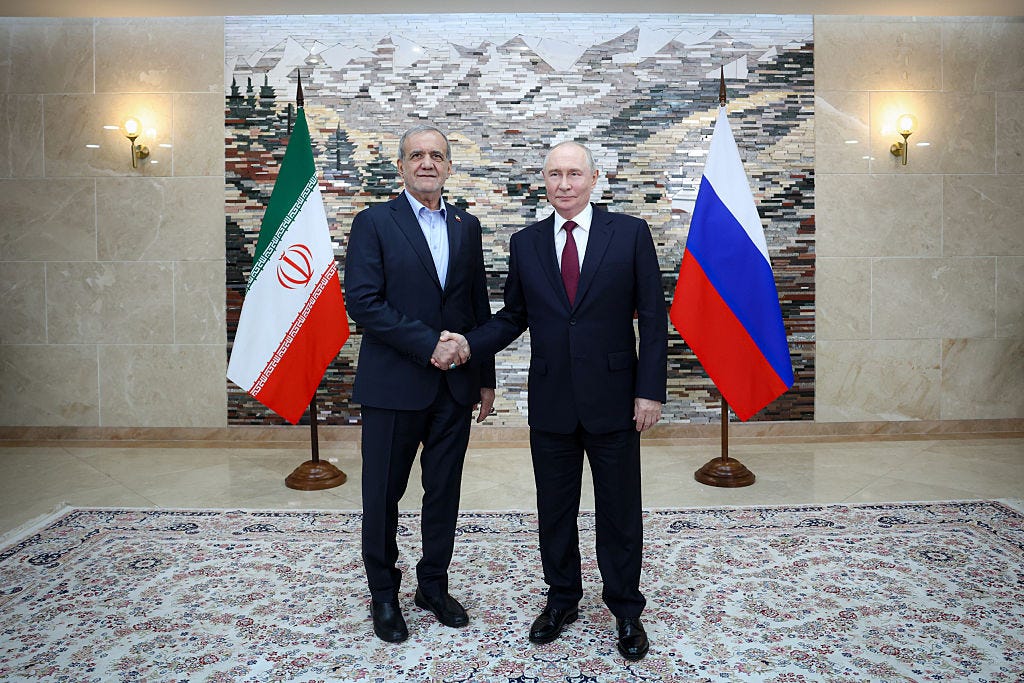
Soon enough, Russia’s engagement with the world became subservient to one single goal: Outlasting the West in Ukraine. Novelties and curiosities in Russian foreign policy resulted from this elevation of war as the chief organizing principle: There was innovation—with Russia’s turn to Iran for Shahed drones, whose production it then localized in the Alabuga Special Economic Zone, enlisting unwitting African students (and, later, North Korean workers) in support. There was improvisation—with Russia’s curation of a fleet of shadow tankers, which ended up not just transporting Russian oil but also serving as launchpads for a drone campaign across Europe. There was radicalization—with Russian pundits threatening Europe with nuclear war with almost soporific predictability. And sometimes, there was restraint—with President Putin abandoning his long-time ally Bashar al-Assad of Syria to his fall in December 2024.
Over 4.5 years into the war, Russia’s versatile global efforts have produced an ambivalent balance sheet. On one hand, its non-Western partners have created a relatively permissive international environment for a war-waging Russia. Russia has sold record amounts of oil to India, diverted trade through the “Eurasian roundabout”, imported North Korean missiles and munitions, and procured vast amounts of Chinese dual-use and other goods. Yet, the sum total of such international support, provided to Russia by die-hard and opportunistic abettors alike, has been insufficient to enable it to win the war.
What’s more, even though Russia has eluded international isolation, its global power projection has eroded. Its Syrian bases, important pillars of its longstanding presence in the Middle East, are currently being downgraded. In the South Caucasus, Russia’s traditional ally Armenia is looking for alternative partners. Just recently, Kazakhstan’s President Tokayev and India’s Prime Minister Modi publicly chided Putin over his forever war.
