
Israel’s Forever War

Donald Trump has already claimed that his promotion of ceasefires in Africa and Asia makes him fully deserving of the Nobel Peace Prize, but if he really wants to be recognised as a top peacemaker, then he needs to do something about the Middle East. This is the big test that has been set for generations of would-be peacemakers, ever since Israel first gained its independence in 1948, and it is particularly urgent now.
Egyptian President Anwar Sadat and Israeli Prime Minister Menachem Begin shared the prize in 1983 for agreeing a treaty, urged on by US President Jimmy Carter. This treaty lasted, although Sadat was assassinated for his troubles in 1981. But to get Begin to agree Sadat had to set the Palestinian issue aside.
Sorting out the occupied West Bank, East Jerusalem and the Gaza Strip then became the main challenge. There was an apparent breakthrough in the early 1990s, based on the Oslo peace accords, leading in 1994 to another peace prize. It was shared by Palestinian leader Yasser Arafat and Israeli Prime Minister Yitzhak Rabin for agreeing a road map to a two-state solution in 1994. The next year Rabin was assassinated, and the prospects never looked quite so bright again, although Bill Clinton put a substantial effort into coming up with a comprehensive solution at the dog end of his presidency in 2000. Finding a way for Israelis and Palestinians to co-exist that have led to failure, disappointment, and disillusion. There have been many ceasefires agreed but that only reflects the regular resort to violence.
Meanwhile, the effort to forge relations between Israel and Arab states that for decades refused to acknowledge its existence has been more successful. Trump believed that his success in getting a number to sign up to peace treaties with Israel in 2020 – the Abraham Accords – was another good reason for him to get the Peace Prize. Saudi Arabia is the most important country yet to sign up, and that is conditional on progress on the Palestinian issue. Another reason why it could seem timely to address this issue is that over the past twelve months, Israel has also seen its most deadly enemies of recent years – Iran and Hezbollah – knocked back and an old enemy – Syria – under new management. Its security environment in principle is more benign than ever before.
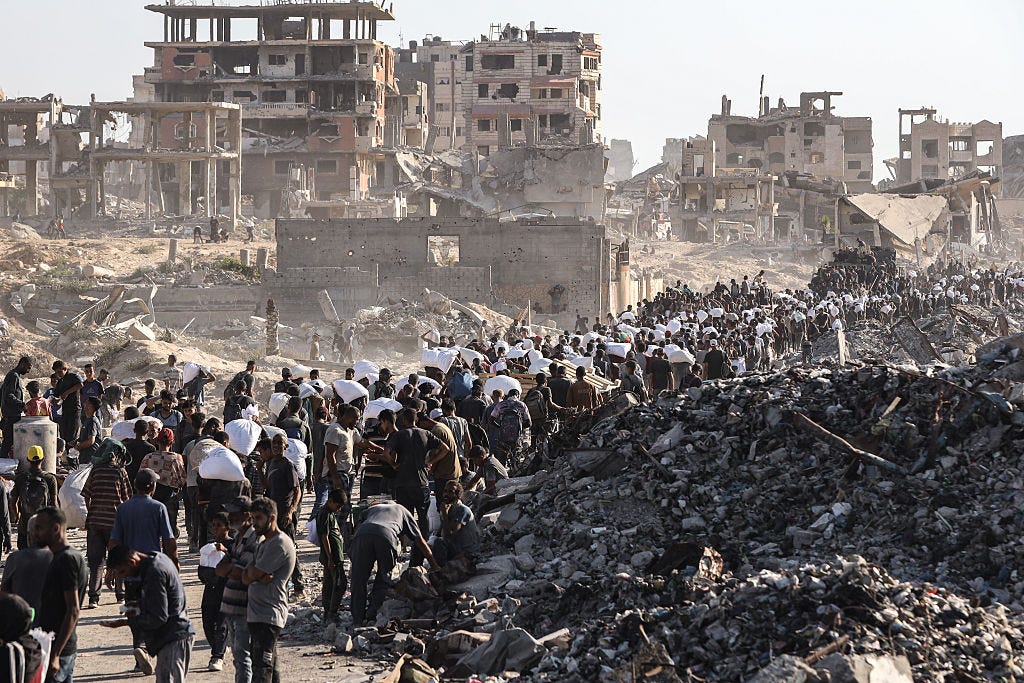
This assessment could even be extended to Gaza, where Hamas as a military force is a shadow of its former self. If Benjamin Netanyahu had chosen to cash in his winnings he could have offered Israel a more hopeful, and more peaceful, future. But he has spent his political career doing his best to thwart such a deal, and he is now in coalition with extremists whose ‘solution’ to this problem would be to see Palestinians expelled from all the occupied territories to make room for more settlers.
The result of the path he has chosen has been to create conditions which make it easier for Hamas to survive and which are steadily turning Israel into an international pariah. The idea of a separate Palestinian state is now being embraced by countries, including the UK, that until recently accepted it only as a pleasant but unrealistic idea. .
I wrote last year explaining my scepticism about a two state solution – not because this would be an undesirable outcome but because there was no plausible way to get there. I saw the most important and immediate task as addressing the dire conditions in Gaza, establishing effective governance in the Strip, and making progress on reconstruction. Since I wrote that, however, the situation inside Gaza has deteriorated further, and recognition of a Palestinian state, as a political project if not yet a functioning entity, is now firmly on the international agenda, presented as the only route to a lasting peace.
There are still grounds for scepticism. This is not going to lead to a Palestinian state any time soon, while the immediate needs of Gaza require urgent attention. But as I shall argue in this post the idea of a Palestinian state, which was accepted by past Israeli governments, has now become a way of warning the current government about the extent of its international isolation.
This is a symptom of a fundamental crisis in Israeli strategy. Netanyahu’s government has set itself objectives it cannot reach while ruling out any political role for Palestinian representatives. But without negotiations it lacks a means of stabilising the situation, let alone getting its hostages back. So long as it has American support the government may take the view that it can resist any pressure to change course. It is unclear whether Trump will back the Israelis in its current strategy for much longer. But what should be of even more concern for Israel is what support it will get following Trump.
Keep reading with a 7-day free trial
Subscribe to Comment is Freed to keep reading this post and get 7 days of free access to the full post archives.