
Is low turnout undermining growth?
A reminder that you can read Lawrence’s post on the Tump-Putin summit here, his next post will look at the outcome. You can also listen to him on the latest episode of the Strategic Minds podcast.
Today’s post is by David Klemperer, one of the best young politics writers around. David is a researcher working at the Constitution Society and at the University of Bath’s Institute for Policy Research. He also co-edits Renewal – a journal of social democracy. In this post he looks at why low turnout doesn’t just undermine democracy but also the economy, and what we could do to fix it.
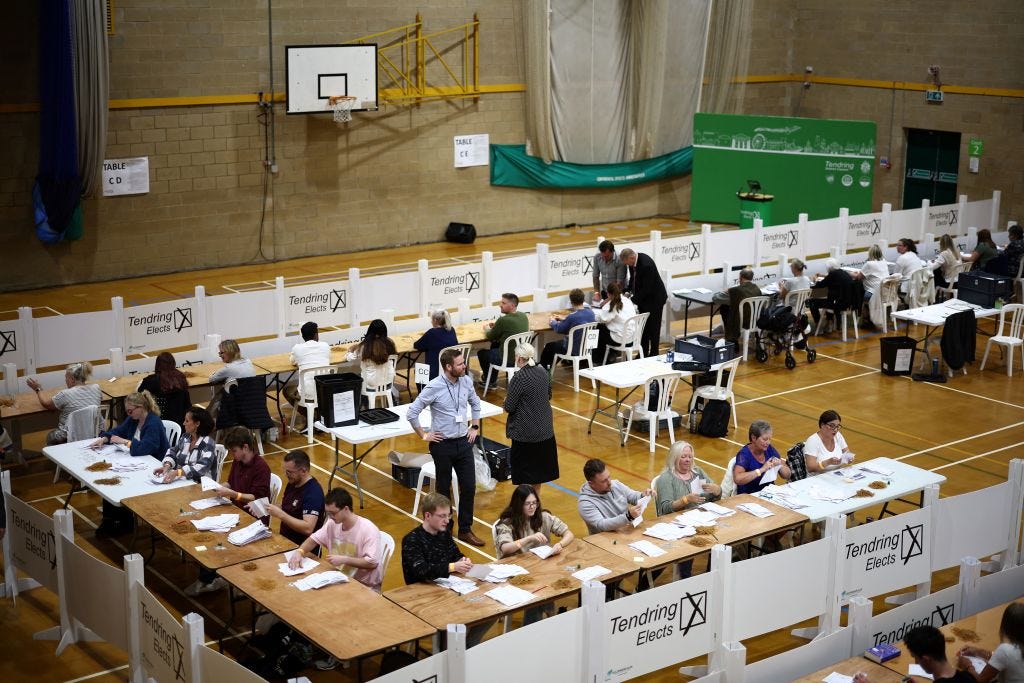
The UK suffers from a chronic and worsening problem of low turnout. Turnout in general elections has been falling gradually from a postwar peak of 84% in 1950, and has now reached crisis levels. At the July 2024 general election, the official turnout rate amongst registered voters fell just shy of 60%; taking into account gaps in the electoral register, the Institute for Public Policy Research has estimated that the real turnout rate was closer to 53%.
In other words, at the last general election, barely more than half of the eligible public bothered to cast a ballot. It is common for commentators to identify the phenomenon of low turnout as one symptom of a wider democratic malaise. Analysts point to rising distrust in politicians, new patterns of media and social media consumption, changing generational norms around political participation, the declining power of states within a globalised economy, and almost two decades of political failure on growth, productivity, and living standards.
But what if low turnout is more than just a symptom? In this post, I suggest that we need to understand low turnout not just as a downstream effect of social, political, and economic failure, but also as an upstream cause. Specifically, there are good reasons to believe that low turnout is an important contributing factor behind growing intergenerational unfairness, persistent economic stagnation, and declining trust in democratic politics.
Unequal turnout and warped political incentives
The most important thing to understand about low turnout is that it is not evenly distributed across society, but that some demographic groups now vote at much lower rates than others.
Specifically, the poor vote less than the rich, the young vote less than the old, ethnic minorities vote less than white people, and the precariously-housed vote less than the secure. Although such disparities are common across advanced democracies, our low baseline level of turnout (12 points below the OECD average) means that they have now become particularly pronounced here in the UK.
The polling firm Ipsos estimates that turnout at the July 2024 general election was:
13 points higher amongst white people than amongst ethnic minorities
22 points higher amongst social grades AB than amongst social grades DE
34 points higher amongst those aged 65+ than amongst those aged 18-24
36 points higher amongst outright homeowners than amongst private and social renters
The result of these disparities is that the UK has been left with an unrepresentative electorate – one that is older, richer, whiter, and more secure than the UK public as a whole.
This unrepresentative electorate directly impacts the outcome of elections: parties whose voter coalition is primarily made up of high-turnout demographics have a significant advantage over those who rely on the shakier support of low-turnout kinds of voters.
Crucially, this fact warps the incentives of the entire political class: politicians and parties are all pushed to disproportionately cater to the preferences of high-turnout demographics – both in the platforms they run on at elections, and in the policies they pursue in government.
The effect of low turnout is that politics becomes skewed towards the interests of the older, the richer, the whiter, and the more secure.
Distributional impacts
The impact of these warped political incentives is perhaps most apparent when it comes to straightforward distributional trade-offs between high turnout and low turnout groups. Internationally, political scientists have long identified a relationship between turnout, redistribution, and inequality: lower turnout is associated with lower levels of redistributive social spending, and thus in higher levels of inequality and vice versa
The logic of this is simple: low turnout almost always means disproportionately low turnout amongst poorer citizens, while high turnout tends to mean more equal levels of turnout across different income groups. When poorer citizens vote, governments are incentivised to redirect resources towards them; when they do not, governments deprioritise their interests. Beyond income inequality, the broader implication of such findings is that governments in democratic countries are highly attuned to the realities of who votes and who does not when it comes to making distributional trade-offs.
Here in the UK, this has recently been most apparent with regard to intergenerational inequalities in welfare provision, which has since 2010 been re-oriented to primarily serve the interests of the elderly: research from the Resolution Foundation shows that between 2007-2008 and 2024-2025, expenditure on benefits for children and working-age adults unrelated to health or housing declined from 2.8% to 1.9% of GDP while spending on the state pension increased from 3.7% to 5% of GDP. In cash terms, changes since 2010 have on average left working-age households £1,500 a year worse off, and pensioners over £800 better off. In part as a result of this shift, while pensioner poverty has almost halved since 1995, child poverty has remained persistently high.
Crucially, this shift was both incentivised and enabled by the persistent disparities in turnout between younger and older age groups, which enabled successive Conservative governments to win re-election on the basis of overwhelming support amongst the elderly, despite increasingly limited support amongst younger generations. Indeed, by 2016 the Resolution Foundation was noting the “correlation between generational voting blocs and the tax and benefit policies being implemented this parliament, which deliver a net benefit to those aged 55-75 set against large losses for those aged 20-40”.
However, while the effects of age-based turnout disparities were undoubtedly magnified over the course of 2010-2024 by the composition of the Conservative Party’s electoral coalition, their impact extends beyond partisan lines. It is illustrative that the current Labour government has found it politically impossible to durably impose a minor reduction in pensioner benefits (means-testing the Winter Fuel Payment), even as it has thus far successfully rejected demands for more spending to combat child poverty (e.g. removing the two-child cap on benefit payments).
Macroeconomic impacts
What about the wider macro-economic impacts of the warped political incentives produced by unequal turnout? In the last few years, an increasing number of analysts have begun warning that the skewed composition of the UK’s electorate risks undermining economic growth.
In August 2020, The Economist suggested that then-prime minister Boris Johnson’s reliance on older voters, whose policy preferences clashed with the “drivers of prosperity in the modern liberal market economy”, risked leaving Britain a “grey and stagnant land”.
Two years later, a similar point was made by the economics writer Duncan Weldon, who linked the preferences of these voters to their distinctive material circumstances. In his book Two Hundred Years of Muddling Through, Weldon argues that:
“The new development in the twenty-first century is the rise of an almost post-economic voting block: the retired and those nearing retirement who are insulated from the day to day gyrations of the economic cycle by guaranteed pensions and asset ownership. And what is more is that they are a group whose share of the population is rising and who are much more likely to vote”.
For Weldon, the electoral power of this “post-economic voting block” of elderly asset owners, strengthened by its propensity to turn out at elections, poses a major obstacle to reviving economic growth in Britain. Weldon frets that such over-represented voters are unlikely to reward governments for successfully pursuing economic growth; rather, they are liable to punish them for attempting pro-growth measures (such as planning reform to allow more housebuilding) that could threatened the values of their assets, and from which they would themselves see little benefit.
Weldon’s argument has been provided with empirical support by the work of Tim Vlandas, a political scientist at the University of Oxford, who has used cross-national data to explore the impact of aging electorates on political and economic outcomes.
Analysing the expressed policy preferences of older voters, Vlandas has found that they prioritise short-term consumption spending on pensions and healthcare over growth-driving social investment in childcare or education.
More importantly, Vlandas has also identified the kinds of economic outcomes that older voters can be empirically shown to electorally reward and punish. He finds that compared with working-age voters, older voters are much less concerned with economic growth and high employment; they are far less likely than working-age voters to either reward governments for delivering them, or to punish them for failing to do so. Conversely however, Vlandas finds that older voters are highly sensitive to inflation, and liable to severely punish any government that presides over it.
These findings show that the distinct material interests of older voters lead them to behave electorally in distinctive ways. Crucially, the consequence of these electoral behaviours is to disincentivise governments from pursuing pro-growth policies, meaning when differential turnout rates produce a disproportionately elderly electorate, the political incentives for governments to deliver economic growth will diminish.
Vlandas suggests three distinct mechanisms through which the electoral preponderance of elderly voters could potentially hinder growth:
Firstly, the preferences of elderly voters “crowd out” necessary social, educational, and infrastructural investments by incentivising governments to prioritise short-term spending on pensions and healthcare.
Secondly, elderly voters undermine aggregate demand at key junctures, by incentivising governments to disproportionately prioritise low inflation over low unemployment. (Indeed, in an earlier set of studies, Vlandas found that in countries with a higher proportion of elderly voters, centre-left parties advocated more fiscally conservative policies; as he has warned, this has the potential to “lock in a low inflation regime, even when this is not economically desirable.”)
Thirdly, by failing to punish poor economic performance, elderly voters both reduce the incentive for governments to pursue pro-growth policies, and increase the likelihood of governments whose policies are antithetical to growth ultimately remaining in power.
This account of how the voting power of the elderly influences policy chimes with the UK’s experience since 2010: in 2015, 2017, and 2019, Conservative governments succeeded in winning re-election despite historically low GDP growth and persistent wage stagnation for working-age adults. Notably, they did so largely on the basis of strong support from older voters (in particular older homeowners) in the context of continuous real-terms increases to both health and pension spending.
We therefore have strong reasons to believe that the UK’s low turnout – and the resulting turnout disparities on the basis of age and homeownership – is creating a situation in which politicians of all parties are encouraged to prioritise low inflation over jobs and growth, and short-term spending on health and pensions over long-term social or infrastructural investment.
Moreover, a further consequence of this situation is that a government like our current one, which professes to be focused on driving investment and growth, is likely to struggle to reap much electoral benefit from successfully delivering on its goals. Instead, such a government would risk electoral punishment for failing to prioritise the short-term consumption preferences and asset values of the old.
Low turnout could ultimately mean that pro-growth governance will be limited to occasional fortuitous interludes, amidst a political system dominated by electorally-incentivised stagnation.
Political impacts
If the picture presented here isn’t already bad enough, there is the potential for a vicious spiral: by incentivising economic stagnation and intergenerational inequality, low turnout risks feeding widespread disillusionment with democratic politics (especially amongst the young), and so driving turnout down ever further.
There is reason to believe that exactly such a vicious spiral is now unfolding in the UK, where falling turnout and its concomitant effects have been accompanied by declining satisfaction with democracy, and declining trust in political institutions – above all amongst low-turnout demographics. After the last general election, polling conducted by More in Common found that a lack of trust in politicians and a lack of belief in the efficacy of voting were the top two expressed reasons for non-voting – cited by over 50% of non-voters.
In addition to deepening stagnation and inequality, the long-term impact of such a spiral would be to gradually build up a pool of discontented non-voters, alienated from the political system, who could potentially be susceptible to populist appeals from anti-system or extremist parties. A low turnout polity is thus one that will progressively become not only poorer and more unequal, but also more politically unstable.
Today, we can see that Reform UK is taking advantage of this situation: exploiting dissatisfaction with British democracy’s failure to deliver, Farage and his party are successfully mobilising specific sections of this pool of alienated non-voters by presenting themselves as challengers to a broken political system and to an out-of-touch political elite. Research from Persuasion UK recently found that almost 20% of current Reform UK supporters are previous non-voters.
Conclusion: the case for compulsory voting
For anyone in the UK concerned with restoring economic growth, intergenerational fairness, and trust in democratic politics, low turnout must be understood as a major political obstacle – one that significantly intensifies the challenge of what Gavin Kelly and Nick Pearce have described as “the perpetually uphill struggle of building broad support for a long-termist social investment agenda”.
The government appears to be conscious of the problem: in its recently-published elections strategy, it has announced its intention to bring forward a range of measures designed to boost electoral participation, including lowering the voting age to 16, expanding the accepted forms of voter ID, and moving towards an automated system of electoral registration.
However, while these measures all reduce barriers to democratic participation, and can be expected to have some positive impact on turnout, alone they are unlikely to be transformative in their effects. A more far-reaching response – and one more likely to yield a significant impact – would be to combine these measures with the introduction of compulsory voting.
Currently used in 22 democracies across the world (including Australia, Belgium, and Brazil), compulsory voting is a tried-and-tested means overcoming low turnout, and of instead ensuring the near-universal participation of eligible voters in elections (in Australia for instance, turnout is typically over 90%).
In the UK context, compulsory voting (perhaps enforced by a fine of around £10, as in Australia) could be expected to drastically reduce demographic disparities in turnout, and thus to significantly improve the incentives facing politicians. Rather than being incentivised to pay disproportionate attention to the interests and preferences of elderly and financially-secure voters, political parties of all stripes would instead be pushed to attend to the needs of the younger, poorer, and more insecure sections of the public who they had previously been incentivised to disregard.
Compulsory voting could encourage governments to pursue policies designed to address intergenerational inequality, boost social investment, and increase economic growth; at the very least, it would make it significantly easier for them to be rewarded electorally for delivering on these kinds of outcomes.
Polling has repeatedly found that the UK public is open to compulsory voting: overwhelming majorities believe that there is a moral duty to vote, and more people are instinctively supportive of introducing a legal requirement to vote than are instinctively opposed to the idea (most recently, YouGov found 48% in favour, and only 42% opposed).
The only question then is this: who amongst the political class will be willing to pick up the gauntlet?
This post draws on David’s recent Constitution Society report, entitled “Universal Suffrage? The problem of low and unequal turnout and the case for compulsory voting”.
Very interesting. Thank you! I still feel that electoral reform is the other key issue. The current electoral system in the UK is failing to reflect the wishes even of those who DO vote - maybe the 20 % of Reform supporters who were previously non-voters reflects the number of those interested in politics/government but don’t vote because, as the old t-shirt said, it doesn’t change anything. A system that more fairly reflected actual votes in a situation where there are more than 2 significant parties would change this in the UK (let alone in the US😵💫)
The issue I’ve had in recent elections is that I find myself voting against people rather than voting for something I want or believe in. With FPTP in recent elections I have had to go with the least worst option - whoever is best placed to stop Corbyn, stop the Tories, etc. It will be the same next time to attempt to stop Reform. I think that turnout would be greater if we had a voting system that allowed us to vote for someone/something we felt positively about rather than hold our noses and vote tactically.