
It’s looming global economic risks week at Comment is Freed. On Tuesday we had a post setting out the threat to global trade and energy prices due to the increasing number of maritime chokepoints. Today we are looking at bond markets, as the global sell-off continues, pushing borrowing costs higher.
Who better to guide us through the complexities of bond trading than Robin Wigglesworth, the author of a brilliant new book telling the history of bonds: “A Fabulous Debt”? Robin is also the editor of the FT’s finance blog “Alphaville” and their former global finance correspondent and US markets editor.
I talked to him about why markets are so nervous, and how things might play out, both in the UK but also the US, given its government debt (“treasuries”) is critical to the mechanics of the global economy. This week the yield on treasuries rose to its highest level since 2007.
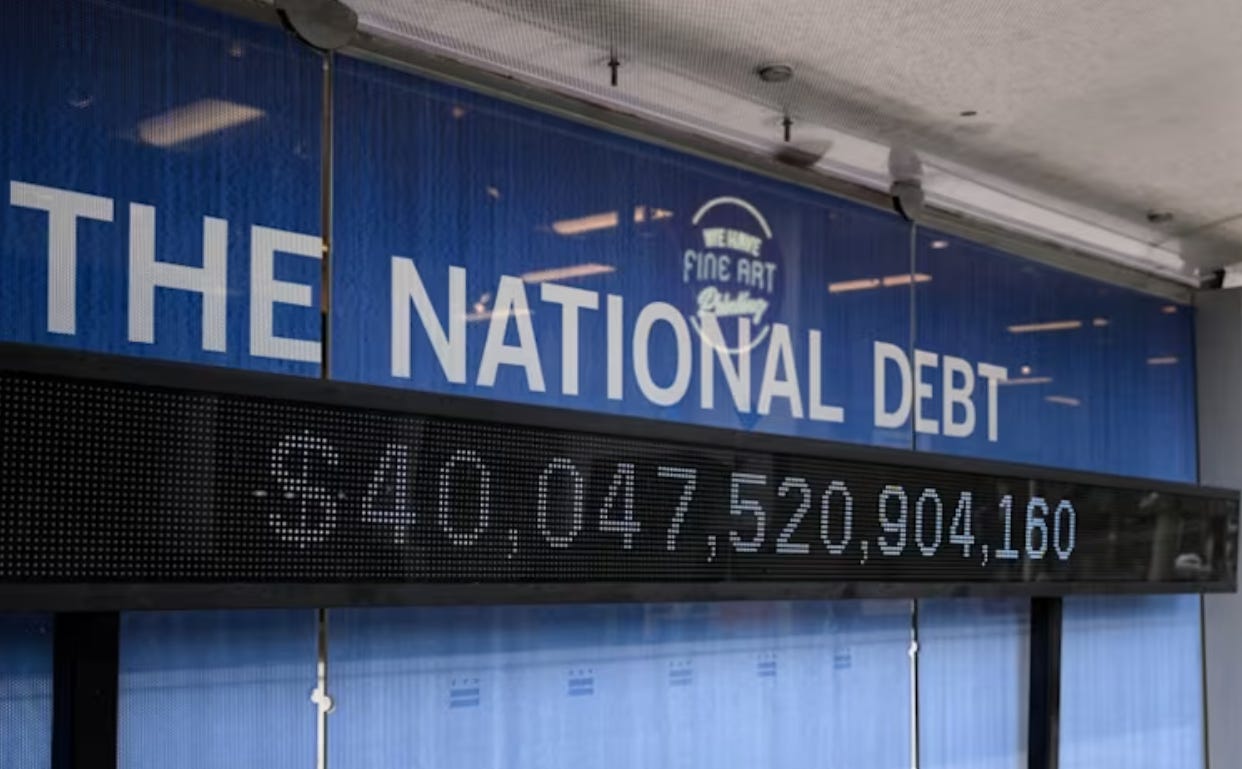
Sam: Let’s start with the question of how much debt is too much. In the book you talk about “Ferguson’s law” – the idea that once debt repayment costs go above defence spending, it’s a sign of national decline. That is now true of the US and the UK, and many other countries. How much validity do you think we can give to that idea?
Robin: I’m not crazy about fastening on to defence spending because that is the superpower way of looking at it. Laws like this are always wrong, but they can be semi-right in interesting ways, and I do think it says something about where we are now.
I am not and never have been in the tribe of debt scolds. But we are in a world where government budget deficits are engorged at a time of no pandemic, and in countries with no wars or crises and fairly solid economic growth. That is unusual and not ideal. We have a corporate sector around the world that for all sorts of legal and regulatory and tax purposes is incentivised to borrow and not be debt free. And we have tax breaks in most countries for people to borrow for their houses as well. So we have a lot of things that encourage the entire system to be more indebted than it really should be, and that inevitably makes the world, the global economy, more fragile than we would want.
Sam: The standard argument about how we’ve gotten to this position is just politics. People don’t like cutting spending. They don’t like raising taxes. So politicians borrow because it’s the easiest route. How much do you think that’s the reason as opposed to changes within the financial system that encourage borrowing?
Robin: They’re hard to disentangle because they reinforce each other. There are these forces that have been encouraging debt for a while. Interest tax breaks for debt payments, especially in the U.S., have led to more aggressive corporate behaviour from private equity and more debt, because that’s the way the owner maximises the payoff versus more standard family-owned companies. Where the founder owns a company they tend to be less indebted. But I do think that something has changed in how we think about these things. Obviously cutting spending has never been popular, but since the 1990s any efforts towards austerity have been very difficult.
The other big way to get out of debt is inflation – that’s been important in the past. The reason why I’m more worried about indebtedness around the world now than I used to be is because I used to think the easier way of solving this would always be with a bit more inflation.
That has losers. It definitely hurts poorer people, though there are ways you can mitigate that. But I thought that high single-digit inflation, which we desperately tried to get in the post financial crisis era for a few years, would do wonders for all these debt ratios.
The single biggest reduction of debt-to-GDP ratios in the world was 2022. But politically, the system just doesn’t seem to be able to handle it nearly as much as it used to. The inflation we’ve seen recently is nothing like we saw in the 1960s and 1970s in some countries. And clearly, our political systems just couldn’t cope with inflation at those levels. And that makes me worry. Debt restructuring in most developed countries is the DEFCON one option. That’s way more painful than anything else. Austerity is very difficult, and now reducing the debt burden through slightly higher inflation for a few years also seems to be impossible as an option. That doesn’t leave us a lot of ways out.