

Today and Thursday we have two posts addressing big risks facing the global economy. This one looks at the risk to global energy supplies and trade, as a result of the ongoing battle over the Strait of Hormuz, now compounded by the threat posed to the Red Sea by the Houthis. Later this week we will post a piece on the state of global bond markets.
We are very grateful to Dr Ian Ralby for providing us with an authoritative and alarming assessment of the challenges facing maritime commerce. Ian is President of Auxilium Worldwide, a charitable nonprofit focused on global harmony and CEO of I.R. Consilium, a maritime and resource security consultancy. Having worked on issues of maritime law, security and international affairs in more than 100 different countries, he serves as an expert advisor to government agencies, international organisations, and private sector entities.
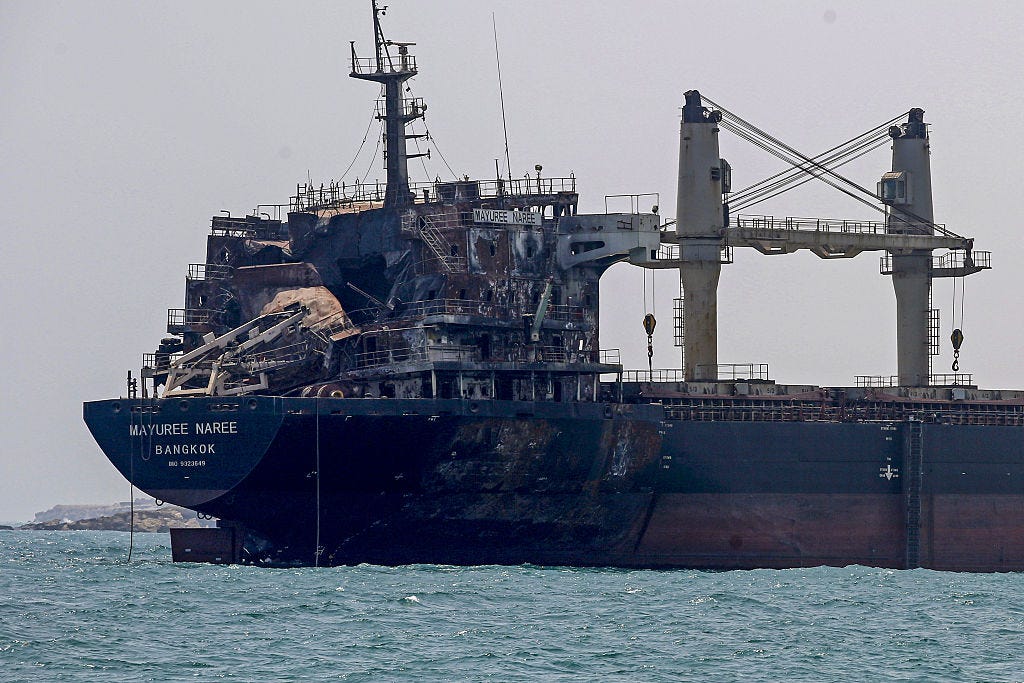
Maritime commerce is responsible for moving roughly 90% of world trade by volume. Almost everything we buy, use, eat, and need travels by boat. Almost 100% of our communication, be it telephonic or internet, goes through the network of submarine cables sitting on the ocean floor. Our way of life on land is entirely dependent on the maritime domain. Today, it is under incredible threat. The physical threat is obvious. We hear about it almost daily when vessels are attacked. But a subtler, more pernicious threat, coming from multiple directions, stands to upend this globalized maritime system on which we so extensively rely.
The challenges to this system can be found around the world’s maritime space - in the Black Sea, Sea of Azov, Caspian Sea, Mediterranean Sea, Baltic Sea, North Sea, South China Sea, Caribbean Sea, the Eastern Pacific Ocean, the Arctic Ocean, and beyond. But the situation is particularly dire in two key chokepoints – the Strait of Hormuz and the Bab al-Mandeb.
The immediate threat posed by the conflicts around these chokepoints, combined with new risks that are emerging, like the return of Somali piracy and the widening of the Ukraine War, could put the world economy in serious jeopardy. The methods by which we have so far avoided a major energy crisis cannot be sustained indefinitely. We have seen oil prices rising sharply again this week.
To fully understand these challenges we first need to put them in the context of the foundational principles of maritime commerce, before looking at how the different crises are merging and turning into a major threat to the global economic system.
