
Capitalism with American Characteristics

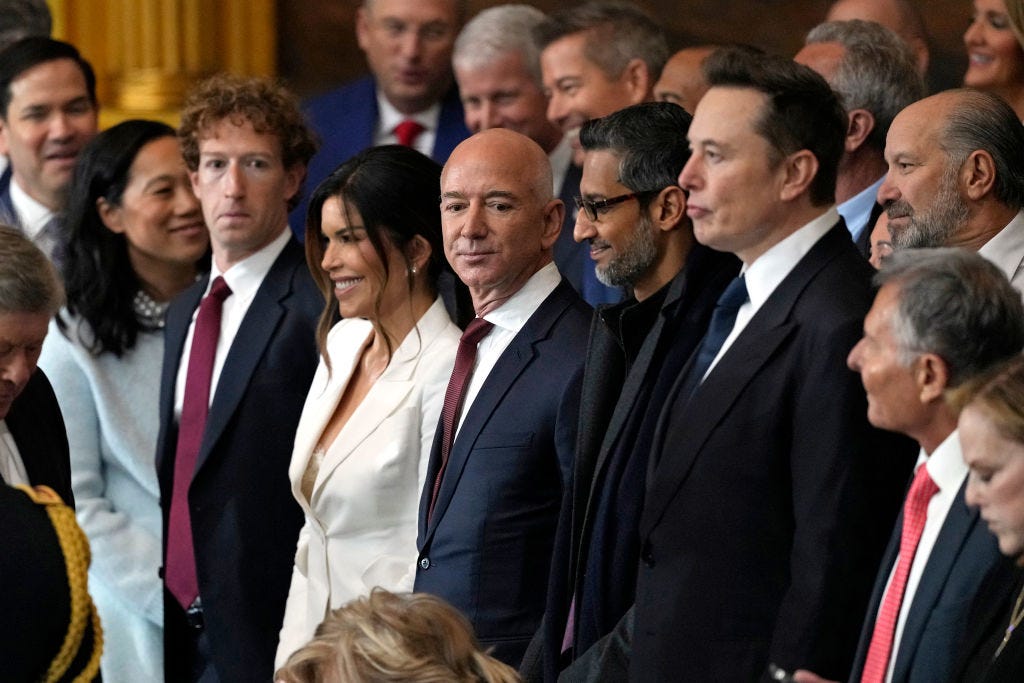
The CEOs of America’s largest companies lined up at Trump’s second inauguration
In between Trump’s inept attempts to end the Ukraine war and take control of Washington DC’s police force, he has made a quite extraordinary series of decisions that are changing the relationship between the US state and big business.
On the 6th August, Trump met with Jensen Huang, the CEO of chipmaker Nvidia, currently the most valuable company in the world. In April, the US government had banned the export of Nvidia’s H20 chip to China on national security grounds as it could enhance surveillance and military capabilities (the Biden administration had already banned sale of more advanced chips). Two days after the meeting with Huang, an export licence was granted. It turned out the quid pro quo for Trump’s agreement is that 15% of the revenue will go to the US government. Another company, AMD, agreed the same deal for one of its slower chips.
It is not clear if this is legal, as export taxes are explicitly banned by the US constitution. But the chips themselves are made in Taiwan by a different company (TSMC) so nothing physical is being exported.
On the 12th, Trump’s spokeswoman, Karoline Leavitt, confirmed that the legalities were being looked into and that “[the deal] could expand in the future to other companies”. It’s a potentially far-reaching precedent that dramatically muddies the water between big business and government. If it is signed off there’s nothing to stop Trump, or anyone else, slapping export restrictions on anything and then demanding cash to allow trade to restart: a straightforward protection racket.
Of course, like many capitalists, Trump has never had much interest in free markets. As a businessman he was quite happy to manipulate New York and other states into giving him massive subsidies. As President he has used economic and regulatory threats to force media companies, law firms and universities into compliance (though some have fought back).
His signature economic policy – tariffs – is economically self-defeating and chaotic in implementation but also offers plenty of opportunities to reward companies willing to work with the administration. We have seen exemptions given to car and tech companies after extensive lobbying. Meanwhile, the government has been trying to insert clauses in tariff trade agreement with other countries around the regulatory treatment of US firms. The announced deal with the EU is being held up due to a US demand to reduce the impact of the Digital Service Act on Silicon Valley tech companies.
Perhaps most worryingly of all, on the 1st August, Trump fired the head of the Labor Statistics Bureau, Erika McEntarfer, claiming, with no evidence, that she had distorted employment figures to make him look bad. Her replacement is an ideologue called E J Antoni, who attended the Capitol riots on the 6th January 2021 (the White House claims it was just out of curiosity) and uses a picture of the Nazi battleship Bismarck as a backdrop for interviews. He is yet to be confirmed by the Senate, but there is no reason to think Republicans will block the nomination.
In the rest of this post I’ll start with the core paradox of capitalism: that capitalists don’t tend to like it much and so it requires a strong state, committed to the rule of law, to work. Then I’ll look at how Trump’s approach towards state intervention in markets is changing the way it functions in the US, showing how he’s starting to emulate China’s “socialism with Chinese characteristics”. And finally I’ll ask where this is heading, and explain why markets and investors should be more worried than they currently seem to be.
Keep reading with a 7-day free trial
Subscribe to Comment is Freed to keep reading this post and get 7 days of free access to the full post archives.