
Build the Rail! Save the Snails!
How to speed up the planning system without trashing the environment

Today we have a guest post from Dan Davies. Dan is a former banker and economist who now writes and consults on regulation and complex systems. He is the author of “Lying for Money”, “The Unaccountability Machine” and the forthcoming “The Problem Factory”. He also has his own substack.
I recommended “The Unaccountability Machine” as one of my 2024 books of the year and wrote about one of the core concepts, “accountability sinks”, in this post. There are few people around writing so thoughtfully on the fundamental flaws in the systems around which our world is built. In this post Dan looks at the real reason our planning system is so slow and expensive. And it’s not bats, snails or newts. This post is based on a longer report with more detail for those who want it and can be found here.
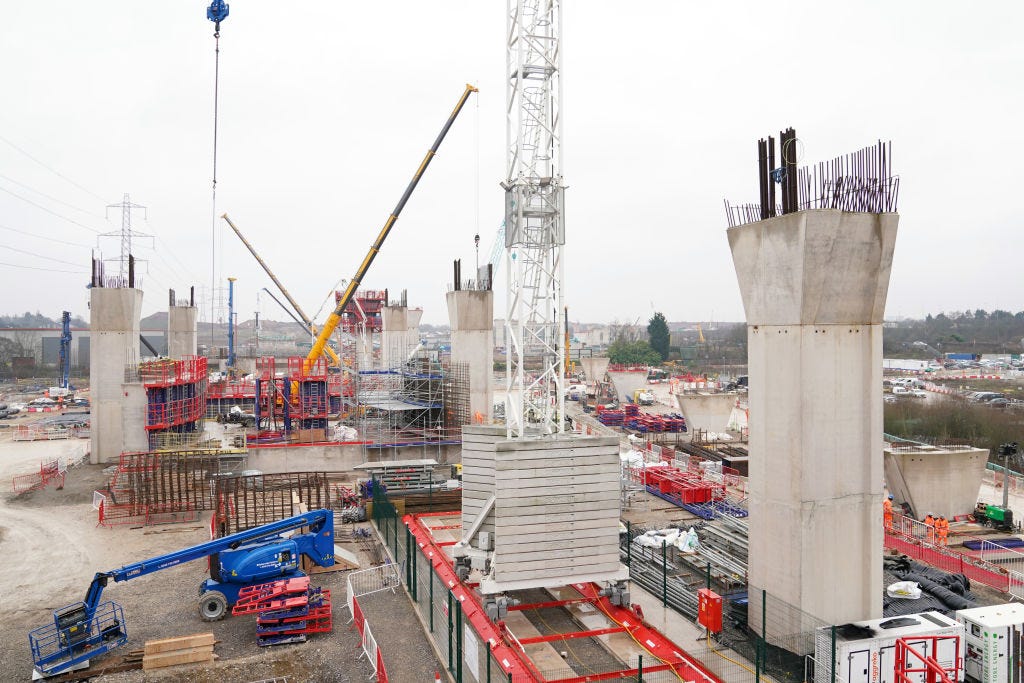
One of the things Labour hope to have delivered by the next election is an ambitious program to “get Britain building”, largely by speeding up the planning process. But if you look at past experience with trying to stimulate growth through deregulation, it’s been disappointing (this is one of the reasons that the Brexit dividend has been so elusive).
It’s a lot easier to blame things on NIMBYism than to accept that the whole structure of planning permission might be broken. What, instead, might a first-principles redesign of the system for Nationally Significant Infrastructure Projects (NSIPs) look like?
We called our paper “Build the Rail! Save the Snails!” because we wanted to challenge one of the central assumptions of the NIMBY/YIMBY debate – that we have to choose between environmental protection and economic growth. People tend to emphasise the need to make trade-offs, but trade-offs are only really necessary when you’re operating at or near the efficient frontier. If you’re doing things in an intrinsically inefficient way there can be win-win solutions, simply by spending less time and effort creating unnecessary problems for yourself.
So let’s start by questioning the initial assumptions. Is the problem really one of over-regulation? Is it really a matter of too many rules and a system that favours NIMBYs? Or are we doing something else wrong?
After all, the YIMBY argument is often made by comparing the cost of power stations and railway construction in Britain to similar projects in France. France is not world-renowned for its streamlined and business-friendly system of bureaucracy; nor is it famous for the progressive and co-operative personalities of its rural residents. The overwhelming bulk of the UK’s environmental regulations are inherited EU law, meaning that they are exactly the same as in countries which seem to do infrastructure much better than us.
It’s not the regulations; it’s the way that the whole British system interacts with them. The UK is a common law country, in which private litigation is an important way to enforce civil rights. It’s also a country with a very congested court system, and one in which the opportunity cost of a barrister’s time is determined by extremely profitable corporate work. This means that when something is taken to court, everything gets very slow and extremely expensive.
And the fear of litigation is, if anything, more destructive than litigation itself. The actual chance of an infrastructure project having its permission quashed by judicial review is about 1.25%. (About a quarter of Nationally Significant Infrastructure Projects are challenged in the courts, and judicial review cases have a failure rate of 95%). This high success rate isn’t a good thing – it’s strong evidence that the whole process happens “in the shadow of the law”, and that everything is being over-engineered to try to avoid the disastrous consequences of losing a judicial review.
The trouble is this is a game that YIMBYs can’t win. In an adversarial system, the potential “risk surface” for any new project – the unknown space of possible legal challenges – is not determined by the regulations themselves, but by the resources of the NIMBYs and the ingenuity of their legal and professional advisors. To put it brutally, if you reduced the UK’s habitat protections by 90%, all that would happen would be that the remaining 10% would be worked ten times harder.
It might even be worse than that. Making it more difficult to bring cases to judicial review is likely to reduce the kinds of challenge that you actually want to happen: those where there is genuine public opposition to a project, or where severe environmental danger has been ignored. But it won’t have anything like the same effect on cynical and strategic objections, brought by people whose real concern is property values, and whose budget to spend on procedural and legal battling is supported by those same property values.
So in order to build infrastructure, we need to change the game.
Start by looking at the very first implicit assumption, that the process for getting “development consent” for an infrastructure project is a matter of quasi-judicial arbitration between the developers and objectors, with the Planning Inspectorate taking a neutral role. That’s wrong to begin with. If something has been identified as a Nationally Significant Infrastructure Project, then that decision ought to matter; a democratically elected government has effectively said that it ought to be built.
But saying “this thing ought to be built” isn’t a statement that can stand on its own. The government has the right to insist we need more data centres, for economic or strategic reasons, but it doesn’t mean that developers should be allowed to build data centres out of papier-mache, or power them by burning tractor tyres, or send construction traffic across a playground. When an infrastructure project is adopted, the government is implicitly saying “this thing should be built, to the relevant standards”.
Where the British system goes wrong is that having said this, the government then reneges on its implicit duty to say what those standards actually are. Instead, it tells the developer to work it out for themselves, and once they’ve done all of the pre-construction work, they’ll get a decision as to whether it was wasted or not. In such a system, it’s pretty obvious that risk-surface thinking is going to prevail. One of the reasons why the cost of HS2 has spiralled out of control is that it is full of measures, like spending £100m on protecting a colony of bats, which individually seem like a cheap way to forestall objections, but which collectively add up to a huge additional expense.
It’s also fairly obvious that what’s bad about this system isn’t any particular regulation, protection or duty, it’s the whole game. As well as encouraging developers to gold-plate their specifications, it encourages anyone with any objection to the scheme as a whole to grab for whatever procedural complaint might serve their interests. Nobody is really incentivised to say what actually needs to be done to deliver a high quality project or to protect the environment. In an adversarial process, it’s impossible to have honest communication. As well as slowing down infrastructure, this tends to discredit the legitimate purposes of environmental regulations and reduce overall trust in the system.
So what’s to be done? It’s that first step that needs to be revisited. Rather than saying “build” and then leaving the market to it, the government should get involved in specifics. The various “statutory consultees” like Natural England, the Environment Agency and local authorities are all, in one way or another, arms of the state. We suggest that rather than a quasi-judicial “Planning Inspectorate”, we need an Infrastructure Directorate which has responsibility for coordinating these consultations, and supervising the public consultation process, in order to produce a full project specification that can be approved. This would be similar to the French Commission National du Débat Publique, a specialised consultation body which is brought in at the earliest stages of major projects to ensure that they proceed with the widest possible legitimacy and consent.
The second big procedural change would be to the workflow of the permission process. We need to encourage people to bring out their objections at the earliest stages when they can be balanced or mitigated, rather than saving them up like pocket aces to play at a strategic moment when they can do the greatest damage. This could be accomplished by requiring that the consultation period concludes with a “Statement of Key Issues”, which would necessarily also be a “Statement of Key Non-Issues”, listing objections which would not be taken any further because they were ill-founded, inconsequential or made in bad faith. Objectors would need to “speak now, or forever hold their peace”, as the key issues document would mark the end of the consultation process and would only be revisited in exceptional circumstances.
The quid pro quo, however, would be that all the issues which passed the initial cut would be the focus of a collaborative problem-solving process between the developer, the authorities and the environmental and public bodies. A list of actual identifiable harms is shorter than a list of hypothetical risks, so it would be reasonable to expect that more could be spent on mitigating each one.
Effectively, we would be transferring expenditure from the “pre-construction” phase to the construction phase. This is a good trade, because pre-construction work is expensive, does not provide direct public benefit and (of course) is entirely wasted if the project is not completed. The UK is not really all that bad during the “shovels in the ground” phase of construction; a 2010 Treasury study found that the overwhelming majority of the difference from global benchmarks was attributable to the project formulation and planning stages.
The final change to the British system might be the biggest challenge; to start to dismantle the adversarial and judicial culture itself. There are relatively few genuinely destructive players in the world of infrastructure and environmental protection; for the most part, developers and consultees all want to ensure that good quality infrastructure is built and that habitats and communities are protected. We need to build a professional community of practice, in which all the parties focus on their long term common interests rather than short term advantage.
We suggest that this could be achieved partly by a significant expansion of state capacity in the planning system (funded by a levy on the industry), but equally importantly by greatly increasing the use of secondments to and from the Planning Inspectorate (or Infrastructure Directorate), both from the construction industry and its professional advisors and from regulatory, environmental and community bodies. If people see their careers as belonging to the infrastructure world as a whole, and assume that they will be on both “sides of the table” at different points in time, they are more likely to adopt constructive rather than cynical approaches.
The paradox of British infrastructure is that our weaknesses are linked to one of our economy’s greatest strengths, the flourishing and vital legal and professional services sector. The problem is not the fault of the bats, or even of the snails or newts. It is a problem we create for ourselves. We could just stop doing that.
 | A guest post by
|
Fascinated post. As always I can only hope that someone in government reads your posts, and actually takes note!
Excellent article, that clearly shows how adversarial politics, where no one from one side can or may agree with anyone from the opposite side, is a very expensive sport. And it explains how come that neither road nor rail infrastructure appears truly finished and doing a satisfactory job in the most efficient way.