
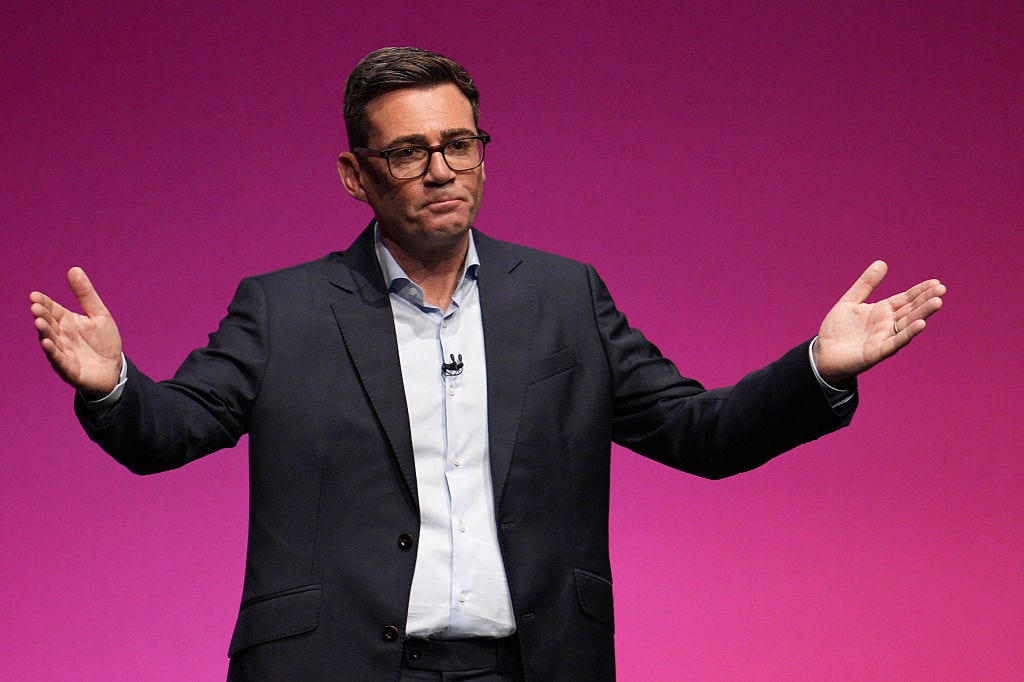
The best employment advice I’ve ever heard is to choose your predecessors wisely. Andy Burnham’s speech on Tuesday was well constructed and delivered with poise and emotion; it would have got good reviews regardless. But the rapturous reception in the hall and in much of the press owed a lot to the contrast with poor Keir Starmer’s tortured performances.
Back in June, when Starmer stepped down, I said I found it odd that so many people thought Burnham would be the same but with a northern accent and a TikTok account. It is even more surprising that some people are still saying it. The two men face many of the same problems, of course, but their approaches are very different. Burnham’s priorities were already clear when I wrote that June post, and they were there again in his speech: social care, electoral reform, devolution, social housing, technical education and public control of utilities. Even after two years in power, it was impossible to know if Starmer had any. You might disagree with Burnham’s beliefs, but they are consistent and genuinely held.
The importance of this is evident to anyone who speaks to Downing Street advisers and officials, many of whom were held over from Starmer. They talk of a PM who is interested in what they are doing, wants to discuss policy and find the best way to convince the public of an argument. This is a complete transformation from the first half of the year. None of this should be particularly worthy of note; it should be the minimum requirement for a prime minister, but it wasn’t there and now it is. Without priorities or purpose, any government will just get buffeted around by events. Having some allows you to keep returning to the core mission when things get difficult. And it allows ministers to make independent decisions that broadly fit an overall narrative.
But having a general sense of where you want to go is different from being sure of the exact destination or knowing how to get there. To make it work, you need a map.
There’s a reasonably clear route to some of Burnham’s objectives, especially those without fiscal implications. Proportional representation can be debated, stuck in the next manifesto and legislated for quickly if he wins. Much can be done on devolution over the next three years, and there has already been a big shift within government. When it comes to changing the economy, though, or transforming public services, there is not much he can do now, and little clarity over what will happen by when. A highly constrained budget to be followed by an even more painful spending review remains the defining reality of this parliament, and much of Tuesday’s speech was an implicit acknowledgement that change in many areas is a long way off.
Then there is a broader question about what this all means in practice. What do all the different themes he keeps coming back to, especially the vaguer ones like reindustrialisation and “a new economy”, mean? The framing of the speech, again unchanged since this summer, is that we have been going in the wrong direction for the last forty years. But how much is he really intending to change? Is this a genuine reversal from “neoliberalism”? What would that even look like?
In the rest of the post, I’ll look at the next steps on the journey, including the budget and spending review. And the questions he still needs to answer about where we are going.